
Building a sub-250 gram FPV drone is the sweet spot of the hobby right now. You get a fully capable freestyle or long-range quad that stays below registration thresholds in most countries, can fly in more places legally, and is cheaper to repair when things go wrong. The challenge is fitting everything into a tight weight budget without sacrificing performance. Here is exactly how to do it.
The Weight Budget
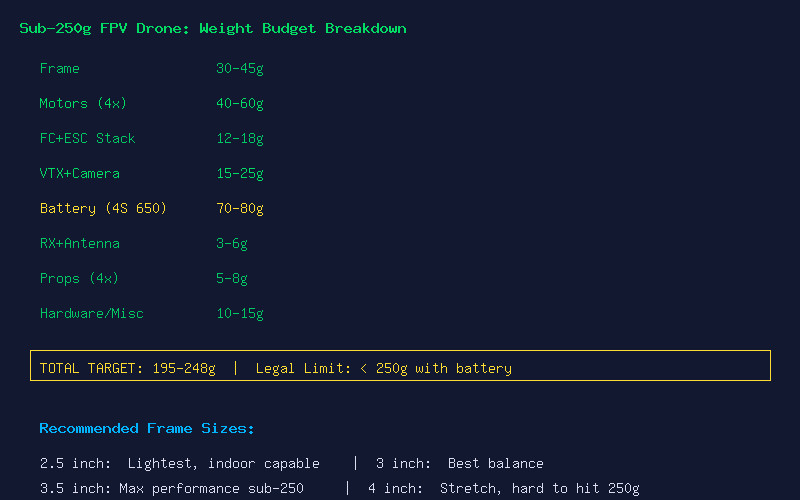
Every gram counts when your ceiling is 249.9 grams including the battery. The biggest weight items are the battery (70-80g for 4S 650mAh) and the frame (30-45g). After that, motors (40-60g total), the flight controller stack (12-18g), and the video system (15-25g for a digital VTX). All-up, you are aiming for 195-245 grams. That leaves almost no room for metal screws, heavy connectors, or bulky 3D printed parts.
Frame Selection: 3.5 Inch Is the Magic Number
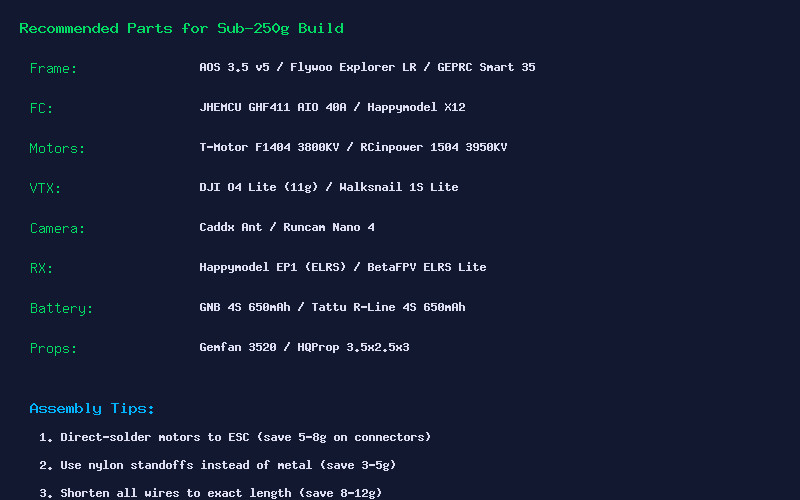
For sub-250g builds, 3.5-inch frames offer the best balance of performance and weight. The AOS 3.5 v5, Flywoo Explorer LR 4, and GEPRC Smart 35 are all proven platforms. A 3-inch frame saves a few grams but sacrifices prop authority — you will feel it in recovery from dives. A 2.5-inch is too small for outdoor freestyle. Skip 4-inch; it is nearly impossible to hit 250g with a 4-inch digital build.
Look for frames under 45 grams with integrated camera mounting. Avoid frames with heavy aluminum cages — TPU canopies save 5-10 grams and work fine for most crashes.
Recommended Parts List
Assembly: Gram-Shaving Techniques
The difference between a 255g build (illegal in many places) and a 248g build (fully compliant) comes down to small decisions:
- Direct-solder everything: Motor plugs, XT30 connectors with removable housings — every connector is 2-3 grams. Direct-solder the motors to the ESC and save 8-12g total.
- Shorten all wires: Measure twice, cut once. Excess wire is dead weight. Trim motor wires to exact length before soldering. Your battery lead should just barely reach the XT30 plug on the battery.
- Nylon hardware: Replace all M2 and M3 steel screws with nylon. The frame stacks are not under shear load — nylon is perfectly fine and saves 5-8g.
- No action camera: A GoPro bare camera body weighs 100g+. Record DVR from the O4 Air Unit or use a Runcam Thumb (16g) if you absolutely need onboard HD.
- TPU canopy, not aluminum: A 3D printed TPU camera mount weighs under 5g and absorbs crash energy instead of transferring it to the frame.
Digital vs Analog: Weight Tradeoffs
The DJI O4 Lite air unit weighs only 11 grams — lighter than many analog VTX and camera combinations. If you want the lightest possible build, the Walksnail 1S Lite VTX (9.5g) with a small camera pushes the boundary even further. For analog purists, a TBS Unify Pro32 Nano (2g) plus a Caddx Ant (2g) gives you a video system under 5g, leaving more weight budget for a bigger battery.
Flight Performance
A well-built 3.5-inch sub-250g quad on 4S with 3800KV motors delivers thrust-to-weight ratios of 8:1 to 10:1 — that is serious freestyle territory. Flight times range from 4-6 minutes of aggressive flying to 8-10 minutes of cruising. The low weight means crashes are less destructive; you will bend props instead of breaking arms.
Building sub-250g is not a compromise — it is an optimization. Lighter quads fly better, crash softer, and cost less. Start your build today.