
Your LiPo batteries are the most dangerous and most expensive consumable in your FPV kit. A single mistake – over-discharging, charging too fast, or storing at the wrong voltage – can destroy a $30-50 pack instantly, or worse, cause a fire that burns down your workshop. This guide covers everything from charging best practices to safe disposal, so your batteries last longer and stay safe.
Understanding LiPo Voltage
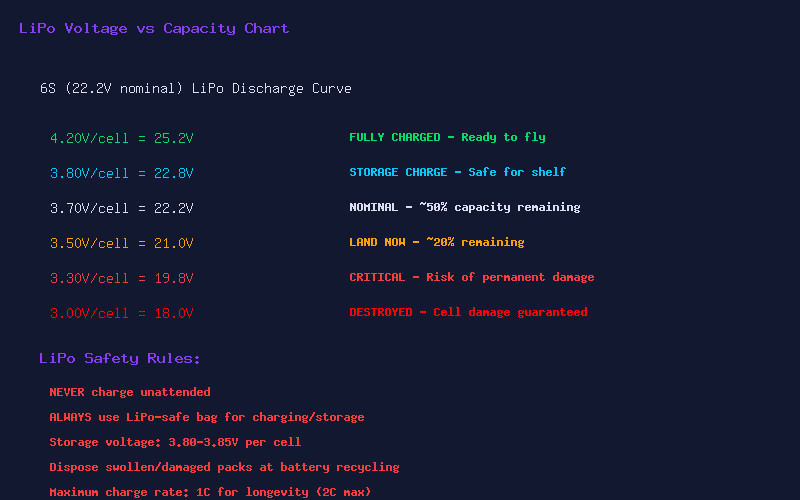
A 6S LiPo has a nominal voltage of 22.2V (3.7V per cell) but operates between 25.2V (fully charged, 4.20V per cell) and roughly 18.0V (fully discharged, 3.0V per cell). However, you should never actually reach either extreme in normal use. The safe flying range is 4.20V to 3.5V per cell – land when your OSD shows 3.5V under load for a 6S pack, and the resting voltage will recover to around 3.70-3.75V.
Charging: The 1C Rule
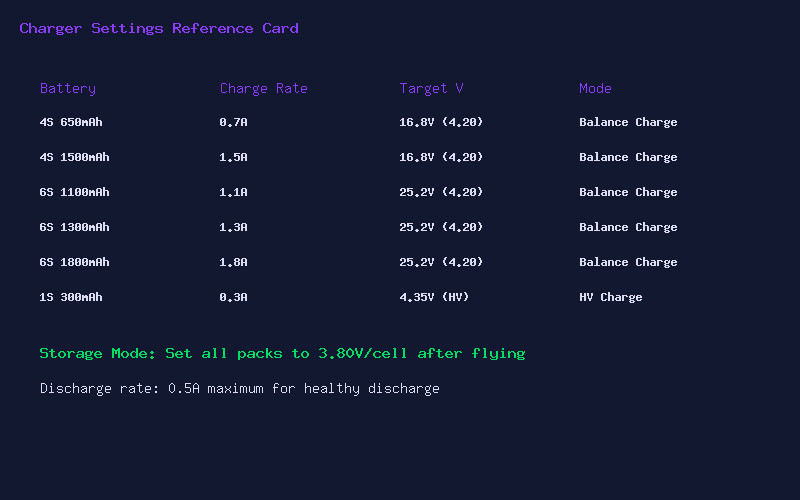
The safest charge rate is 1C, which means charging at a current equal to the battery capacity in amps. For a 1300mAh pack, that is 1.3A. At 1C, a fully discharged pack takes about 45-60 minutes to charge. You can charge at 2C (2.6A for a 1300mAh) for faster turnaround, but this increases internal heating and gradually reduces cycle life. Never exceed the manufacturer maximum charge rate – usually 3C to 5C depending on the brand.
Always use balance charge mode. This charges each cell individually to exactly 4.20V. Fast charge and standard charge modes do not balance and will eventually cause voltage drift between cells, leading to one cell sagging prematurely and the entire pack becoming dangerous.
Storage Voltage: The Longevity Secret
LiPo cells degrade fastest when stored at full charge. Every day a pack sits at 4.20V per cell, the internal resistance increases measurably. For maximum lifespan, store all packs at 3.80-3.85V per cell. Most chargers have a dedicated “Storage” mode that automatically charges or discharges to this voltage. After a flying session, storage-charge any packs you will not use within 24 hours.
Safety Rules That Save Lives
- Never charge unattended. Fires start in seconds. Stay in the room with your charger.
- Use a LiPo-safe bag or ammo box for charging and storage. A metal ammo can with the seal removed (for pressure venting) is the gold standard.
- Charge on a non-flammable surface. Concrete garage floor, ceramic tile, or a metal shelf. Never charge on carpet, wood, or near curtains.
- Inspect every pack before charging. Swollen cells, punctured shrink wrap, or a sweet chemical smell means the pack is compromised – discharge and recycle immediately.
- Keep a fire extinguisher nearby. A Class D (metal fire) extinguisher is ideal, but a standard ABC is better than nothing. Sand in a bucket also works for smothering a LiPo fire.
Disposal of Damaged or End-of-Life Batteries
When a pack is puffed, has a dead cell, or has exceeded its useful cycle life (typically 200-300 cycles for high-discharge FPV packs), it must be disposed of properly. First, fully discharge the pack to 0V using a dedicated discharger or a light bulb/resistor setup. Then take it to a battery recycling facility – most electronics stores and home improvement centers accept LiPo batteries. Never throw LiPos in household trash; they can cause garbage truck and landfill fires.
Treat your batteries with respect and they will deliver hundreds of flights. A little discipline around charging, storage, and inspection keeps your workshop safe and your wallet happy.