
Introduction
The flight controller is the brain of your FPV drone. It processes gyroscope data, runs the PID loop, and translates your stick inputs into motor commands thousands of times per second. Choosing the right FC is critical for flight performance, reliability, and future expandability. Here are our top 5 picks for 2026.
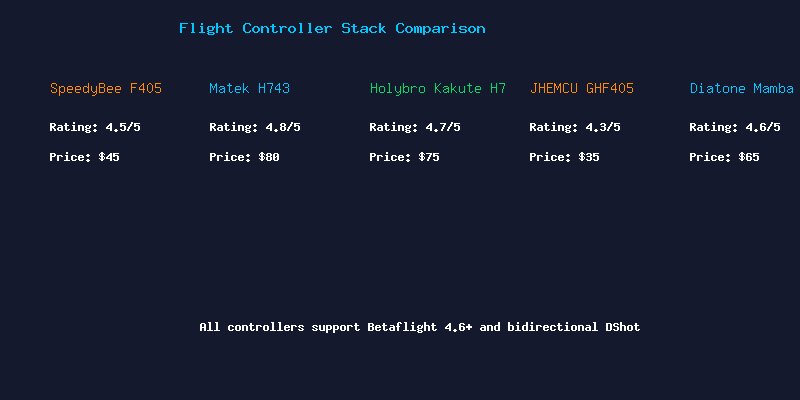
1. SpeedyBee F405 V4 The Community Favorite
The SpeedyBee F405 V4 dominates the market with its unbeatable price-to-performance ratio. Built around the STM32F405 processor running at 168MHz, it handles 8kHz gyro and 8kHz PID loop rates with ease. The built-in Bluetooth module lets you configure Betaflight wirelessly from your phone a game-changer for field tuning. At around 5 for the stack (FC + 4-in-1 ESC), it is the default recommendation for any 5-inch build.
2. Matek H743 Slim The Long Range King
Matek H743 Slim features the powerful STM32H743 processor at 480MHz, giving it massive headroom for complex INAV setups with GPS, compass, barometer, and multiple UARTs. It supports ArduPilot for autonomous missions and has an onboard OSD chip. The 6-layer PCB design ensures clean power delivery. At 0, it is the premium choice for 7-inch long-range builds.
3. Holybro Kakute H7 V2 The Race Winner
The Kakute H7 has been a staple in competitive FPV racing. The H7 processor at 480MHz with ICM-42688-P gyro delivers ultra-low noise and vibration resistance. The plug-and-play ESC connector eliminates soldering on the stack. The built-in barometer and 16MB blackbox flash are welcome additions. At 5, it is worth every penny for serious pilots.
4. JHEMCU GHF405AIO Budget King
The JHEMCU GHF405 AIO packs a flight controller and 4-in-1 ESC onto a single 25.5×25.5mm board. Ideal for micro builds, whoops, and 3-inch toothpicks. With F405 processor, built-in ExpressLRS SPI receiver option, and support for 2-4S batteries, it is remarkable value at 5. Expect slight compromises on ESC durability at the 20A limit.
5. Diatone Mamba F722 MK4 The All-Rounder
The Mamba F722 MK4 uses the STM32F722 processor with more flash memory than F405 boards, enabling full Betaflight feature sets. The stack includes a robust 55A BLHeli_32 ESC capable of handling 6S power with 2306 motors. At 5, it is a solid mid-range option for freestyle builds.
Betaflight vs INAV vs ArduPilot
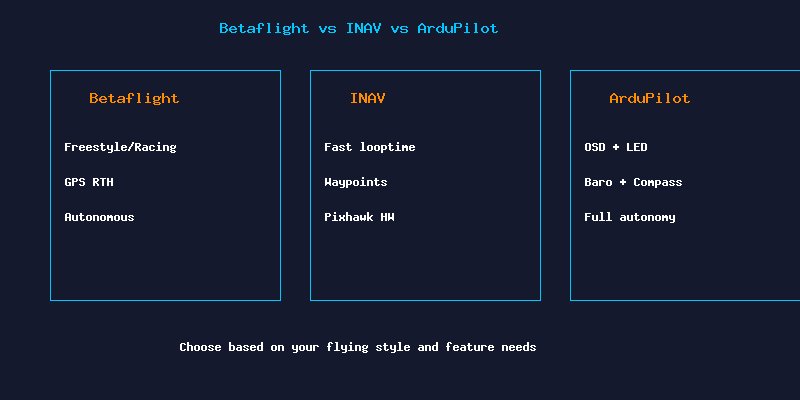
Betaflight: The go-to firmware for freestyle and racing. Lightning-fast looptimes, comprehensive OSD customization, and massive community support. Ideal for 99% of FPV pilots.
INAV: Focuses on GPS-assisted flight modes like position hold and return-to-home. Perfect for long-range cruising and aerial photography. Requires barometer and compass on your FC.
ArduPilot: Full autopilot suite with waypoint missions, terrain following, and advanced failsafes. Runs best on H7-class hardware. Overkill for most FPV use cases but unmatched for autonomous flight.
Key Specs to Look For
- Processor: F405 (168MHz) is the minimum. F722 and H743 offer more UARTs and processing power for advanced features.
- Gyro: ICM-42688-P or BMI270 are the current standards. Avoid older MPU6000 gyros on new builds.
- UART count: You need at least 4: one for receiver, one for VTX control, one for GPS, and one spare.
- Blackbox: Onboard flash (8MB+) for recording flight data and tuning PIDs.
- Mounting: 30.5×30.5mm for standard builds, 20x20mm or 25.5×25.5mm for micro builds.
Conclusion
For most pilots building a 5-inch freestyle quad in 2026, the SpeedyBee F405 V4 offers the best value. Long-range pilots should stretch to the Matek H743. Budget builders will love the JHEMCU AIO. Whatever you choose, stick to well-supported hardware from established brands to ensure firmware updates and community support for years to come.