
Introduction
Long range FPV flying is one of the most rewarding disciplines in the hobby. There’s nothing quite like cruising over mountains, exploring abandoned structures, or flying along coastlines from miles away. But achieving reliable long range performance requires careful attention to your antenna and VTX setup — arguably the most critical system in your entire build.
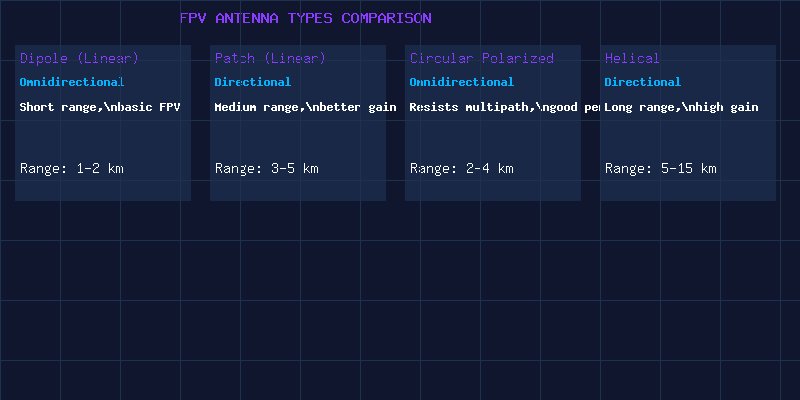
Understanding FPV Antenna Types
Dipole (Linear) Antennas
Simple, lightweight, and inexpensive. Dipoles are stock on most budget VTX modules and produce a donut-shaped radiation pattern. They work well for short range but suffer from multipath interference — radio signals bouncing off surfaces create ghost images in your feed.
Range: 1-3 km in ideal conditions. Best for: Park flying, beginner setups.
Circular Polarized (CP) Antennas
RHCP (Right Hand) or LHCP (Left Hand) antennas are the standard for serious FPV. The circular polarization rejects multipath interference far better than linear antennas. The signal spirals as it propagates, and reflected signals reverse their polarization, effectively being rejected by the receiver.
Critical rule: Transmitter and receiver antennas MUST match polarization (both RHCP or both LHCP). Mismatched antennas lose 20-30dB of signal — essentially rendering your system blind.
Range: 3-8 km. Best for: Freestyle, mid-range, most FPV flying.
Patch Antennas (Directional)
Patch antennas focus their reception in one direction rather than all around. On the receiver side, a good patch antenna combined with an omnidirectional provides coverage both in front of you (where you fly) and behind you. Some pilots run dual patches on diversity receivers.
Range: 5-10 km. Best for: Long range flying where you fly in one general direction.
Helical Antennas
The extreme long-range choice. Helicals provide enormous gain (8-14 dBi) in a tight beam. They must be aimed at the aircraft for best results, making them ideal for ground station setups with antenna trackers. The narrow beam can be a problem if you fly outside the coverage cone.
Range: 10-30 km+. Best for: Extreme long range with antenna tracking.
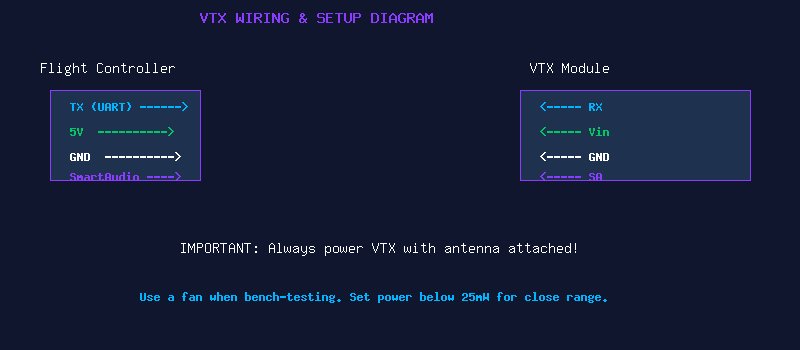
VTX Power and Frequency Selection
VTX output power is measured in milliwatts (mW). Higher power = more range, but also more heat and battery drain.
- 25mW: Legal limit in many countries without a license. Good for 200-500m range. Use for racing events where everyone is close.
- 200mW: Good balance for park flying (1-2 km). Most pilots can fly comfortably at this power level.
- 400-800mW: Solid mid-range power (3-6 km). Requires a fan when bench-testing — these VTXs get hot fast.
- 1W-2W (1000-2000mW): Long range power (8-15 km). Absolutely requires antenna attached during power-on. These VTXs can destroy themselves in seconds without an antenna load.
Frequency bands: 5.8GHz is the standard for FPV video transmission. The R-band (5658-5917 MHz) and E-band (5705-5945 MHz) are most common. Use a frequency far from other pilots and avoid overlapping channels.
Receiver and Goggle Considerations
Your video receiver is just as important as your transmitter. Modern goggles come with built-in diversity receivers that constantly switch between multiple antennas, picking whichever has the strongest signal at any moment.
RapidMix and Fusion: These advanced receiver modules don’t just switch between antennas — they combine signals from both antennas into a single cleaner image. The difference is night and day for long range flying. If you’re serious about range, skip the basic diversity module and invest in a Fusion-style receiver.
Long Range Antenna Setup Tips
- Mount antennas vertically: CP antennas radiate in a horizontal plane. Mounting both VTX and receiver antennas vertically (pointing up/down) maximizes signal overlap.
- Keep antennas away from carbon fiber: Carbon blocks RF signals. Extend your VTX antenna away from the frame using a TPU mount or a rigid SMA extension.
- Use quality connectors: Cheap SMA/RP-SMA connectors introduce signal loss. Use genuine Amphenol or similar quality connectors for critical builds.
- Avoid sharp bends in coax: The coax cable feeding your antenna should have gentle curves. Sharp 90° bends damage the shielding and cause signal leakage.
- Match your antenna to your flying style: If you fly all around yourself, use omnis. If you fly primarily in one direction, add a directional antenna on your goggles.
Legal and Safety Considerations
In most countries, VTX power above 25mW requires a ham radio license (Technician class in the US). Check your local regulations. Additionally, always follow line-of-sight rules, respect altitude limits, and never fly near airports or restricted airspace. Long range FPV is amazing, but it comes with responsibility.
Conclusion
For most pilots moving into mid-range flying (3-8 km), a setup with a quality 800mW VTX, a good RHCP antenna on the quad, and a diversity receiver with one omni and one patch antenna on the goggles is the sweet spot. It provides excellent range without the complexity of ground stations or antenna trackers. Remember: antenna quality matters more than raw VTX power. A well-tuned antenna system at 400mW will outperform a cheap antenna at 1W every time.