
The 250-Gram Threshold and Why It Matters
Staying under 250 grams all-up-weight (AUW) is the holy grail of FPV drone building. In most jurisdictions — including the United States (FAA), European Union (EASA), Canada, and Australia — sub-250g drones face dramatically fewer restrictions. No Remote ID requirement, no registration in many countries, and the ability to fly in more locations without special waivers. But building a long-range FPV drone that stays under 250 grams while carrying HD video, GPS, and enough battery for a 15+ minute flight is a serious engineering challenge.
Frame Selection: Every Gram Counts
The frame is the foundation of any weight-conscious build. For a sub-250g long-range quad, 3-inch and 3.5-inch frames strike the ideal balance. The Flywoo Explorer LR 4-inch V2 frame weighs just 32 grams and accommodates 4-inch props with enough surface area for efficient cruising. The BetaFPV Pavo35 frame at 28 grams is another excellent choice for 3.5-inch builds. For ultimate lightweight performance, the HGLRC Rekon35 frame at 22 grams with 3.5-inch props can achieve remarkable efficiency.
Avoid aluminum standoffs where possible — nylon hardware saves 2-3 grams. Titanium screws are lighter than steel but the weight savings are marginal for the cost. Remove unnecessary frame parts: if you never crash hard (long-range cruising is gentle flying), you can strip protective bumpers and TPU mounts you do not strictly need.
Electronics That Punch Above Their Weight
The flight controller and ESC stack is where significant weight can be saved. The JHEMCU GHF405AIO all-in-one board combines FC, 4-in-1 ESC, and ELRS receiver on a single 6.5 gram PCB. Pair it with 1404 or 1504 motors in the 3000-4000 KV range for 3.5-inch props on 4S. T-Motor’s F1404 3800KV motors weigh only 9.5 grams each while producing up to 280 grams of thrust on 4S with 3.5-inch bi-blades.
For GPS, the Flywoo GOKU GM10 Nano V3 GPS module weighs a mere 3.2 grams and provides Galileo + GPS + GLONASS positioning with compass. The Happymodel EP2 ELRS receiver at 0.5 grams provides full diversity reception at a weight penalty you will not notice. For video, the Walksnail Avatar HD Nano V3 system at 16 grams (camera + VTX) delivers full 1080p HD with onboard DVR recording — eliminating the need for a heavy action camera.
Battery Selection: The Biggest Compromise
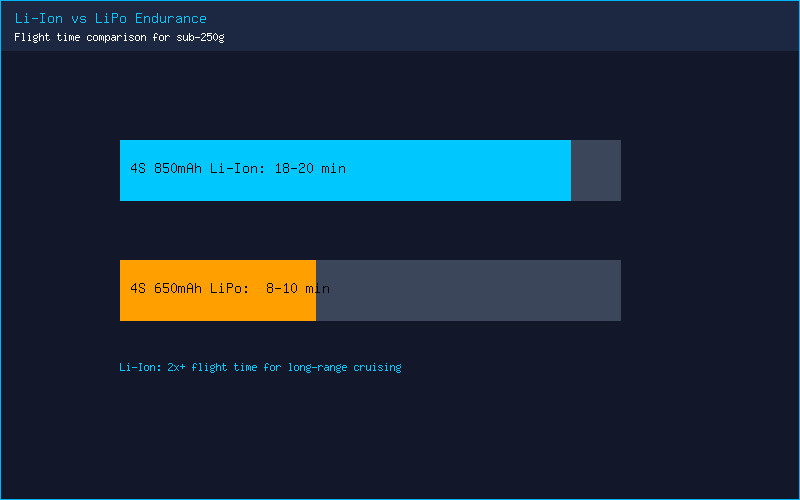
The battery is always the heaviest single component. For a sub-250g long-range build, a 4S 850 mAh Li-Ion pack using Samsung 40T or Molicel P42A 21700 cells weighs approximately 140 grams. Li-Ion cells provide far higher energy density than LiPo — you trade peak current for extended flight time. A 4S 850 mAh Li-Ion pack can deliver 18-20 minutes of gentle cruising, while a comparable LiPo of the same weight would give only 8-10 minutes.
The Tattu R-Line 4S 650 mAh LiPo at 74 grams is the lightweight alternative if you prefer punch over endurance. Combined with the 21700 Li-Ion option, you can swap packs depending on your mission: LiPo for proximity flying and freestyle, Li-Ion for long-range cruising and mountain surfing.
The Final Weight Budget
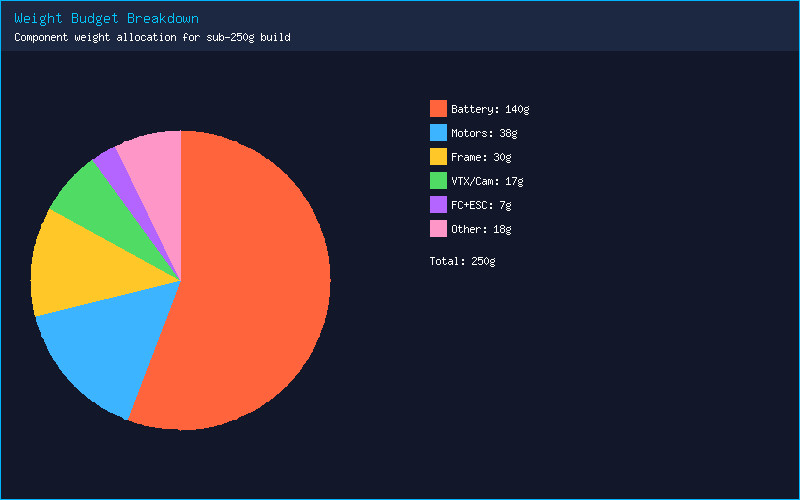
A carefully optimized build: frame 30g + AIO board 7g + motors 38g + props 6g + GPS 4g + receiver 1g + Walksnail VTX 16g + antenna 2g + wiring 8g + battery 140g = 252 grams. Slightly over, but substituting a 650 mAh LiPo at 74g brings the total to 186 grams — well under 250g and still capable of 10+ minute flights. With careful component selection and a willingness to trade peak power for endurance, a sub-250g long-range FPV drone that flies 15+ minutes is absolutely achievable in 2026.
Have you built a sub-250g long-range quad? What is your secret to saving weight? Let us know!