
Introduction
The FPV video system landscape in 2026 is more diverse than ever. Pilots can choose from five distinct ecosystems: time-tested analog, DJI’s premium O4 digital system, Walksnail’s versatile GX platform, HDZero’s latency-optimized racing system, and the emerging OpenIPC open-source alternative. Each system has fundamentally different trade-offs in image quality, latency, range, and cost. This guide breaks down every option to help you choose the right video system for your flying style and budget.
Analog: The Eternal Workhorse
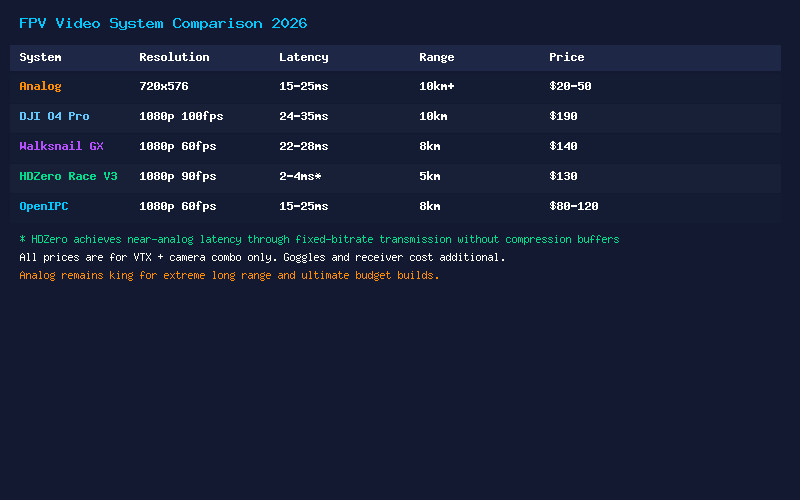
Analog FPV refuses to die — and for good reason. At $20-50 for a complete VTX and camera setup, analog is dramatically cheaper than any digital system. The technology is mature, debugged, and supported by an enormous ecosystem of compatible hardware from dozens of manufacturers.
Analog’s killer feature is predictable signal degradation. As signal strength drops, the image gradually becomes snowy — giving you continuous feedback about link quality and time to turn back. Digital systems, by contrast, maintain a perfect image until they suddenly drop to a frozen frame or black screen. For long-range pilots pushing the limits, this gradual degradation is a safety feature.
Modern analog with a good receiver module (RapidFIRE, TBS Fusion) and a quality camera (Caddx Ratel 2, Foxeer T-Rex) produces surprisingly good 720×576 video. The image will never match digital clarity, but it is perfectly flyable and free of compression artifacts. For budget builds, tiny whoops, and extreme long range, analog remains the practical choice.
DJI O4 Pro: The Image Quality King
DJI’s O4 Pro system (released late 2025) raises the bar for FPV image quality. Recording 1080p at 100fps with H.265 encoding, the O4 delivers footage that looks closer to a GoPro than traditional FPV video. The 1/1.3-inch sensor captures dramatically more light than previous generations, making dusk and overcast flying genuinely enjoyable rather than barely survivable.
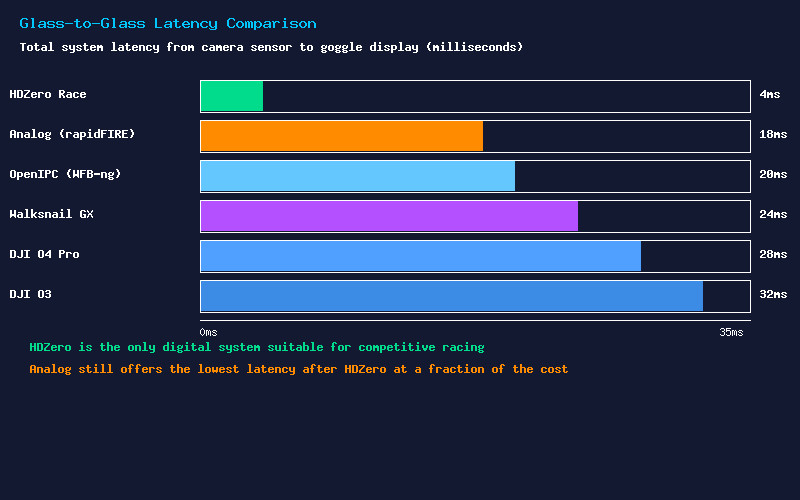
The O4 Pro’s Achilles heel is latency. At 24-35ms glass-to-glass (depending on mode and bitrate), it is the slowest of the major systems. For freestyle and cinematic flying, this latency is acceptable. For competitive racing, it is disqualifying. The system also carries DJI’s typical ecosystem lock-in: you must use DJI goggles (Goggles 3 or Integra), and the VTX is 190 — easily the most expensive option.
If image quality is your absolute priority and you fly cinematic or freestyle, the DJI O4 Pro is the best system available. The recorded onboard footage from the O4’s DVR is good enough that many pilots skip carrying a separate action camera entirely.
Walksnail Avatar GX: The Versatile Choice
Walksnail has carved out a strong position as the system that works with everything. The Avatar GX system (2026 refresh) outputs 1080p at 60fps with 22-28ms latency — splitting the difference between DJI’s quality and HDZero’s speed. At $140 for the VTX and camera, it undercuts DJI by $50.
Walksnail’s key advantage is compatibility. The system works with Walksnail’s own goggles (Avatar HD, Goggles X), but also with many HDZero goggles via the VRX module, and with analog goggles via HDMI input. You are not locked into a single goggle ecosystem. The Walksnail 1S Lite VTX at 9.5g enables HD digital video on sub-250g builds where DJI’s heavier hardware is impractical.
Walksnail’s weakness is historical: early firmware had reliability issues with random signal dropouts. The 2025-2026 firmware updates have dramatically improved stability, but the reputation lingers. Current production hardware is solid, and Walksnail offers the best price-to-performance ratio in digital FPV.
HDZero Race V3: For Pilots Who Need Speed
HDZero takes a fundamentally different approach to digital video. Instead of compressing frames with H.264/H.265 (which inherently adds latency), HDZero transmits uncompressed or lightly compressed video at a fixed bitrate. The result is 2-4ms glass-to-glass latency — essentially analog-speed with digital clarity.
The HDZero Race V3 VTX outputs 1080p at 90fps. The image quality is good but not DJI-good: the fixed bitrate means detail can look slightly soft in complex scenes with lots of grass or trees. But in motion, the low latency creates a connected, responsive feel that no other digital system approaches. For competitive racing, HDZero is the only viable digital option.
HDZero goggles ($600) are expensive but serve as a universal receiver: they accept HDZero, analog (via expansion module), and Walksnail (via VRX). This makes them the most flexible premium goggle on the market, though the upfront investment is significant.
OpenIPC: The Open-Source Wildcard
OpenIPC is the newest entry and the most exciting for tinkerers. Built on open-source firmware running on commodity IP camera hardware, OpenIPC promises digital HD video without vendor lock-in. Current hardware (RunCam Wifilink, OpenIPC AIO boards) delivers 1080p at 60fps with 15-25ms latency using the WFB-ng transmission protocol, at prices ($80-120) well below proprietary systems.
OpenIPC is not yet ready for plug-and-play users. Setup requires Linux comfort, configuration files, and a tolerance for debugging. But for the open-source community, it represents the future: a digital FPV system where you control every parameter, from bitrate to encryption, with no proprietary firmware or forced obsolescence.
Choosing Your System
- Budget builds and tiny whoops: Analog. Nothing beats $20 VTX plus $15 camera.
- Cinematic and freestyle: DJI O4 Pro if budget allows; Walksnail GX for better value.
- Racing: HDZero Race V3 — the only digital system fast enough for competitive racing.
- Sub-250g digital: Walksnail 1S Lite or HDZero Whoop Lite.
- Open-source enthusiast: OpenIPC — support the future of open FPV.
- Hybrid approach: HDZero goggles with analog module and Walksnail VRX — fly every system from one goggle.
Conclusion
The “best” FPV video system in 2026 depends entirely on your priorities. DJI O4 delivers unmatched image quality at the highest price and latency. Walksnail offers the best balance of quality, latency, and ecosystem flexibility. HDZero is mandatory for racers who demand analog-speed response. Analog remains unbeatable for value and predictable long-range performance. And OpenIPC represents the exciting open-source future. There has never been a better time to fly FPV — whatever system you choose, the view from the goggles has never looked better.