
Choosing the right motors is arguably the most impactful decision in an FPV drone build. Too low KV and your quad feels sluggish. Too high and you’ll smoke an ESC or drain batteries in two minutes. This guide demystifies KV ratings, stator sizes, and thrust curves so you can pick the perfect motor for your flying style.
1. What Does “KV” Actually Mean?
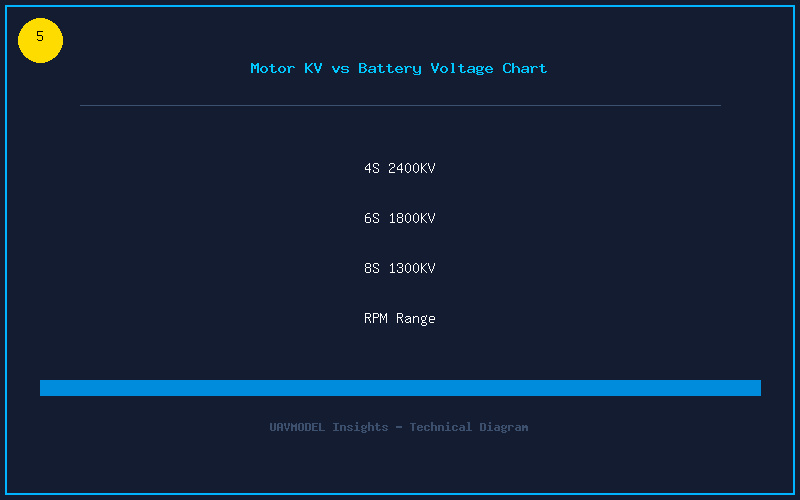
KV stands for RPM per volt with no load. A 1800KV motor running on 6S (25.2V full charge) theoretically spins at 1800 × 25.2 = 45,360 RPM. In practice, load, prop size, and battery sag reduce this by 25-35 percent. The critical thing to understand: KV is not power — it is the gearing ratio of your electric power system. Higher KV equals more RPM per volt but less torque. Lower KV equals more torque but needs more voltage to achieve the same RPM.
2. KV Selection by Battery Voltage
This is the most common question in FPV. Here is the cheat sheet for 5-inch freestyle builds:
| Battery | KV Range | Prop Size | Flight Character |
|---|---|---|---|
| 4S (16.8V) | 2400-2700KV | 5.0-5.1″ | Smooth, forgiving, longer flight time |
| 6S (25.2V) | 1700-1950KV | 5.0-5.1″ | Punchy, responsive, modern standard |
| 6S (25.2V) | 1950-2100KV | 4.3-4.5″ | Ultra-responsive, racing setup |
| 8S (33.6V) | 1200-1400KV | 5.0-5.1″ | Extreme efficiency, niche builds |
Rule of thumb: Multiply battery voltage by KV to get your target RPM range. For 5-inch freestyle, aim for 38,000-45,000 RPM at full charge. Stay within that band and you will have a flyable quad. You can find top-quality motors from brands like Xing, T-Motor, and iFlight at UAVMODEL.
3. Stator Size — The Numbers That Matter
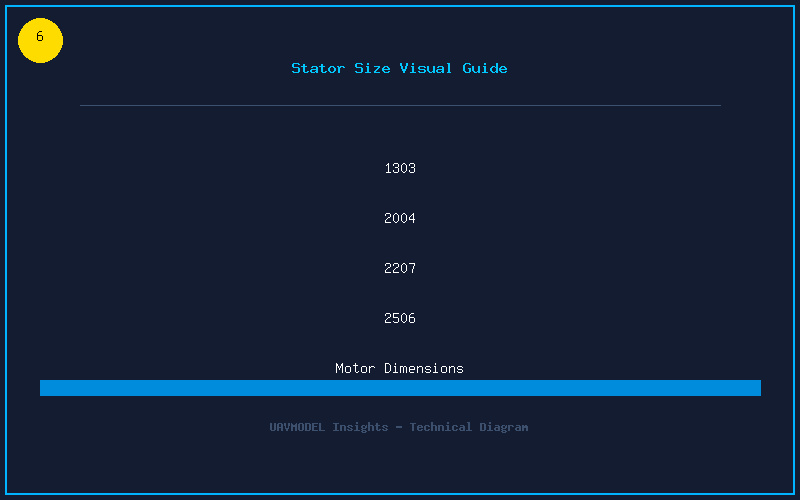
Motor names like “2207” or “2306” tell you the stator dimensions: 22mm diameter by 07mm height (or 23 by 06). Bigger stator means more copper, which means more torque and power handling. But also more weight.
- 2207 / 2306 — The 5-inch sweet spot. Excellent balance of torque and weight. Handles aggressive freestyle and moderate racing.
- 2207.5 / 2306.5 — Slightly taller stator for more low-end grunt. Great for heavier builds carrying a GoPro.
- 2004 / 2105.5 — Lightweight motors for 3-4 inch builds. Prioritize weight savings over raw power.
- 2506 / 2806.5 — Big torque for 7-inch long-range. Spinning larger props efficiently at lower RPM.
- 1303 / 1404 — Micro motors for 2-3 inch toothpicks and whoops.
Stator volume rule: Diameter squared times Height gives you a rough power comparison. A 2207 has a volume index of about 3,388 while a 2306 is about 3,174 — very close, and they perform similarly.
4. Motor Construction — What You Are Paying For
Price differences between motors come down to manufacturing quality:
- N52SH curved magnets — Premium motors use high-temperature curved magnets that maintain field strength under heat. Budget motors use flat N35 magnets that lose flux at high temperatures.
- Single-strand vs multi-strand winding — Single thick copper strand fills the stator more efficiently than multiple thin strands, giving lower resistance.
- Titanium alloy shaft — Resists bending in crashes. Steel shafts on budget motors bend on the first hard hit.
- Precision bearings — Japanese EZO or NSK bearings run smoother and last longer than generic Chinese bearings.
- Dynamic balancing — Factory-balanced rotors reduce vibration. Premium motors include balancing putty visible inside the bell.
5. Matching Motors to Your Flying Style
Here is the practical advice for different pilots:
- Beginner freestyle: 2207 1700-1800KV on 6S. Forgiving, efficient, and will not rip your arms off. Xing-E Pro or Emax Eco II series.
- Aggressive freestyle: 2306 1800-1950KV on 6S. Instant punch for throwing the quad around. T-Motor Velox or Xing2 series.
- Racing: 2207 1950-2100KV on 6S with lightweight props. Maximum RPM. Prioritize low weight over durability.
- Cinematic / Long Range: 2506 1200-1500KV on 6S spinning 7-inch bi-blades. Efficiency and smoothness over punch.
- Cinewhoop: 2004 2900-3500KV on 4S or 6S (depending on KV). Enough torque for ducts and a full GoPro payload.
Motor selection does not need to be complicated. Pick a reputable brand within the KV range for your battery, match the stator size to your frame class, and spend your tuning time on PID optimization rather than second-guessing motor specs.