
Introduction
Your FPV drone’s battery is its heart — choose the wrong one and you’ll suffer from voltage sag, short flight times, or even a fire. Choose the right one and your quad will deliver consistent power throughout the entire flight. This guide covers everything you need to know about LiPo battery selection, care, and safety.
Understanding LiPo Battery Specifications
Cell Count (S-Rating)
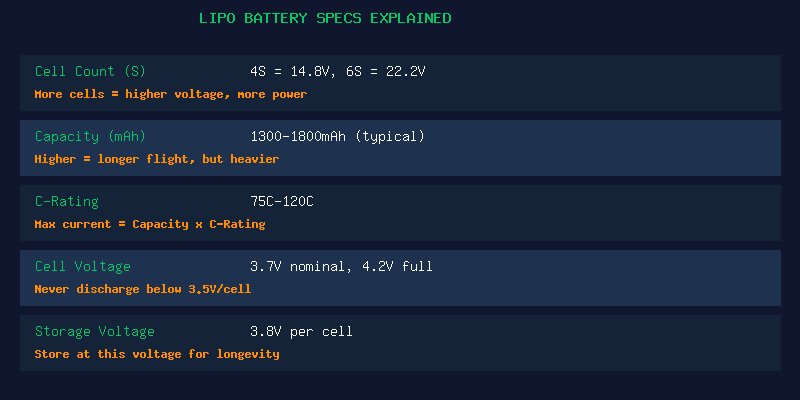
LiPo batteries are composed of individual cells, each with a nominal voltage of 3.7V (4.2V fully charged). The “S” rating tells you how many cells are in series:
- 1S: 3.7V — Tiny whoops and micro drones
- 3S: 11.1V — Lightweight 3-4 inch builds
- 4S: 14.8V — Classic FPV standard, still widely used
- 6S: 22.2V — Modern standard for 5-inch and larger builds
Higher voltage means more power with less current draw. This is why 6S has become the standard: a 6S 1300mAh battery at 22V can deliver the same power as a 4S at 15V while drawing 30% less current. Less current = less heat, less voltage sag, and happier ESCs.
Capacity (mAh)
Measured in milliamp-hours, this tells you how much energy the battery stores. Typical capacities for 5-inch builds:
- 1050-1300mAh: Lightweight racing and freestyle. 3-4 minute flights.
- 1300-1550mAh: Standard freestyle capacity. 4-6 minute flights.
- 1800-2200mAh: Long range cruising. 8-12 minute flights on 7-inch builds.
- 3000-6000mAh: Li-Ion packs for extreme range (20+ minutes).
C-Rating (Discharge Rating)
The C-rating tells you the maximum safe continuous current the battery can deliver. Formula: Max Current = Capacity (in Ah) × C-Rating.
Example: A 1300mAh (1.3Ah) battery rated at 100C can theoretically deliver 130 amps. In practice, C-ratings are often exaggerated by manufacturers. A “true” 75C battery is excellent — anything claiming 120C+ is likely marketing. For 5-inch freestyle pushing hard, aim for at least 75C real-world rating.
LiPo Battery Safety: Non-Negotiable Rules
LiPo batteries store enormous energy in a small package. When treated properly, they’re safe and reliable. When abused, they can catch fire violently.
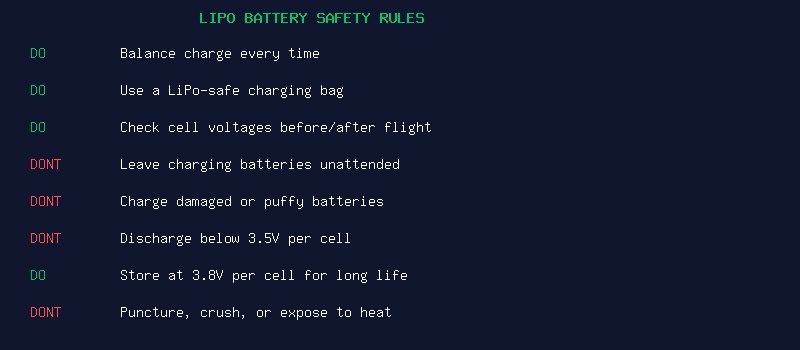
- Always balance charge. Never use a charger that doesn’t balance each cell individually. An unbalanced battery is a fire waiting to happen.
- Use a LiPo-safe charging bag. A $10 fireproof bag could save your house. Charge batteries inside the bag, on a non-flammable surface.
- Never leave charging batteries unattended. Stay in the room. If something goes wrong, you need to react immediately.
- Inspect before every charge. Check for puffing, damaged balance leads, punctures, or swollen cells. Any sign of physical damage = retire the battery safely.
- Discharge to storage voltage after flying. Leaving batteries fully charged for more than 24 hours degrades them rapidly. Storage voltage is 3.80-3.85V per cell.
- Dispose of damaged batteries properly. Discharge completely using a light bulb or dedicated discharger, then take to a battery recycling facility. Never throw LiPos in regular trash.
Maximizing Battery Lifespan
- Land at 3.5V per cell: Under load, your voltage sags. Land when the resting voltage (after a few seconds of hovering) reads 3.5V. Going below 3.3V per cell causes permanent damage.
- Store at 3.8V per cell: This is the sweet spot for long-term storage. Most chargers have a “Storage Charge” mode that handles this automatically.
- Avoid heat: Don’t leave batteries in a hot car. Temperatures above 60°C (140°F) can permanently damage LiPos and increase internal resistance.
- Warm up before hard flying: In cold weather (below 15°C / 60°F), warm batteries to room temperature before flying. Cold LiPos have higher internal resistance and sag badly under load.
- Track internal resistance: Modern chargers can measure per-cell IR. Healthy cells typically show 2-8 milliohms. If one cell’s IR is significantly higher than the others, that battery is aging and should be retired from heavy use.
Li-Ion vs LiPo for Long Range
For extreme long range flying (15+ km), Li-Ion packs (18650 or 21700 cells) offer significantly higher energy density. A 6S 4000mAh Li-Ion pack can deliver 20-30 minutes of cruising flight, while a comparable-weight LiPo might only give 12-15 minutes. The tradeoff: Li-Ion cells can’t deliver the burst current needed for aggressive freestyle. They’re strictly for efficient cruising.
Recommended Batteries
5-inch Freestyle (6S): CNHL Black Series 1300mAh 100C, Tattu R-Line 1400mAh 120C
5-inch Racing (6S): Dogcom 1300mAh 120C, GNB 1100mAh 120C (lighter for racing)
Long Range (6S): Samsung 40T 21700 Li-Ion packs (4000mAh), Sony VTC6 18650 packs (3000mAh)
Conclusion
Your battery is not just a power source — it’s a performance component that directly affects how your quad flies. Invest in quality batteries from reputable brands (CNHL, Tattu, GNB, Dogcom), treat them with respect, and follow safe charging practices. The small premium you pay for good batteries pays off in flight performance, cycle life, and most importantly, safety.