
Introduction
Batteries are the lifeblood of your FPV drone — they determine flight time, throttle response, and ultimately, how much fun you have per session. The two dominant battery chemistries in FPV, LiPo (Lithium Polymer) and Li-Ion (Lithium-Ion cylindrical cells), serve fundamentally different purposes. Understanding when to use each, how to manage them safely, and what smart battery features are worth paying for will save you money and improve your flying experience.
LiPo Batteries: Maximum Power, Minimum Weight
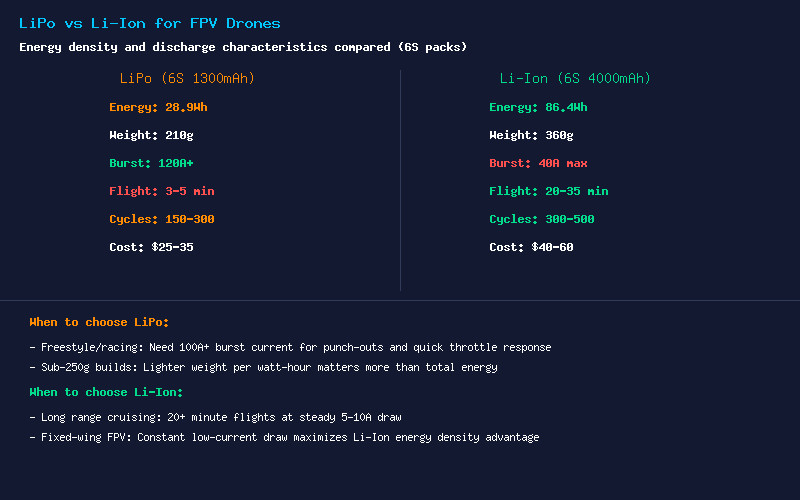
LiPo packs have dominated FPV for over a decade because they deliver what pilots need most: enormous burst current in a lightweight package. A quality 6S 1300mAh LiPo weighs approximately 210g and can deliver 120A+ burst current — enough to launch a 5-inch freestyle quad from 0 to 100km/h in under a second.
The trade-off is energy density and cycle life. LiPo packs store about 130-140 watt-hours per kilogram. A 1300mAh 6S pack holds just 28.9 watt-hours, giving you 3-5 minutes of aggressive flying. Under high current draw, voltage sag is significant — a pack reading 25.2V at rest will drop to 21-22V at full throttle, reducing effective power and heating the battery internally.
LiPo cycle life is 150-300 cycles with proper care. The primary degradation mechanism is internal resistance (IR) increase. A new pack might have 5-10 milliohms per cell; at end of life, 20-30 milliohms is common. Higher IR means more voltage sag and more heat, which accelerates further degradation in a vicious cycle.
Li-Ion Batteries: Endurance Champions
Li-Ion packs built from cylindrical 18650 or 21700 cells flip the LiPo equation: lower burst current but dramatically higher energy density and cycle life. A 6S 4000mAh Li-Ion pack using Molicel P42A 21700 cells weighs approximately 360g and stores 86.4 watt-hours — roughly 3x the energy of a similar-weight LiPo.
The cost of that endurance is current capability. Li-Ion cells are rated for 15-45A continuous (depending on cell model), with voltage sag becoming severe above their rated current. A 6S 4000mAh Li-Ion pack flown at a gentle 8-10A cruise will deliver 20-35 minutes of flight. Punch that same pack to 60A for a power loop and voltage will sag to 19-20V, producing dramatically less thrust than a LiPo at the same throttle position.
Li-Ion cycle life is 300-500 cycles — roughly double LiPo. The chemistry is more tolerant of deep discharge (though you should still avoid below 3.0V/cell), and internal resistance increases more slowly over time. For long-range pilots putting 10-20km on a pack, Li-Ion is not just more convenient — it is the only viable option.
The Discharge Curve: Why Voltage Matters
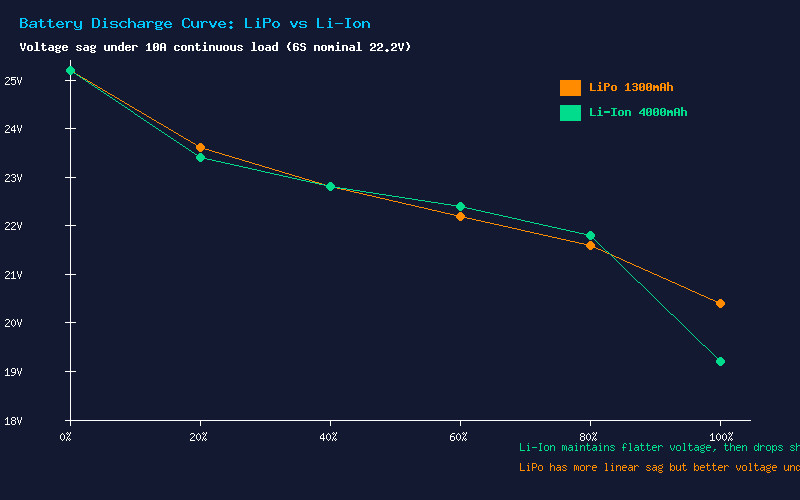
The voltage curve under load tells you everything about how a battery will perform in flight. LiPo packs have a relatively linear voltage decay: they start at 25.2V (6S fully charged), drop to about 22.2V at 50% capacity, and hit 21.0V near empty. This linear behavior makes mAh counting a reliable way to estimate remaining flight time.
Li-Ion packs have a flatter discharge curve through the middle 60% of capacity — voltage sits around 22.5-23.0V for most of the flight — then drops sharply in the final 20%. This makes voltage-based flight time estimation unreliable: you will see 22.5V for 15 minutes, then suddenly 20.0V with very little warning. Always use a current sensor and mAh counter when flying Li-Ion packs, and land at 80% of rated capacity (3200mAh consumed from a 4000mAh pack).
Temperature affects both chemistries significantly. LiPo internal resistance doubles when cold (below 10C), causing more voltage sag and less flight time. Li-Ion is slightly less temperature-sensitive but still loses 15-20% capacity at 0C. Keep packs warm (body temperature) before flight in cold weather for best performance.
Building Your Own Li-Ion Pack
Pre-built Li-Ion packs are available from a few manufacturers (Auline, GNB, Flywoo), but building your own is straightforward and saves 30-40% on cost. You will need:
- Cells: Molicel P42A (4200mAh, 45A) for high-current builds; Samsung 50S (5000mAh, 25A) for maximum endurance cruising; Sony/Murata VTC6 (3000mAh, 30A) for a middle ground.
- Nickel strip: 0.15mm pure nickel for series connections. Do not use nickel-plated steel — it has higher resistance and will heat up under load.
- Spot welder: A basic $40 spot welder from Amazon is sufficient. Soldering directly to cells risks heat damage to the internal separator.
- Balance leads and XT60: Standard 6S balance connector and quality XT60 (Amass brand).
- Fish paper and Kapton tape: Insulate all exposed connections. A shorted Li-Ion pack is just as dangerous as a shorted LiPo.
- Heat shrink: Large-diameter PVC heat shrink (100mm flat width) to wrap the finished pack.
The pack configuration for a 6S 4000mAh battery is 6 cells in series (6S1P). If you need more capacity, build a 6S2P (12 cells, 8000mAh) for fixed-wing applications. Always use matched cells from the same batch — mixing cells of different ages or models will cause imbalance issues.
Battery Safety and Care
FPV batteries store enormous energy in a small package. A 6S 1300mAh LiPo contains about 104 kilojoules — roughly the muzzle energy of a .22 caliber rifle round. Respect that energy and follow these rules:
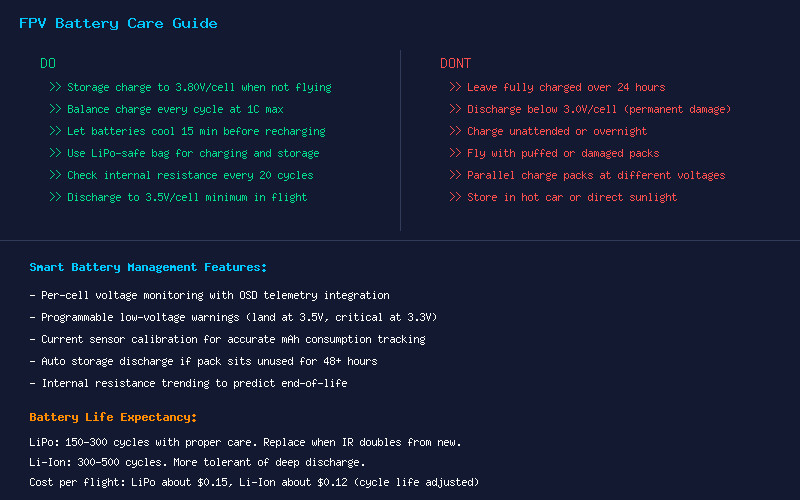
- Storage voltage: 3.80-3.85V per cell. Leaving packs fully charged for more than 24 hours accelerates degradation. Leaving them discharged below 3.5V risks permanent damage.
- Charge rate: 1C is ideal (charge a 1300mAh pack at 1.3A). 2C is acceptable for field charging when time matters. Never exceed the manufacturer’s maximum charge rate (usually 2-5C for modern packs).
- Cool-down time: Let packs cool to ambient temperature before recharging — at least 15 minutes after a hard flight. Charging a hot pack accelerates degradation and increases fire risk.
- Internal resistance tracking: Most modern chargers display per-cell IR. Track this over time. When IR doubles from new values, the pack is nearing end of life.
- Physical inspection: Any puffing, denting, or punctures mean immediate retirement. Do not attempt to “revive” a physically damaged LiPo.
Smart Battery Features Worth Your Money
Smart batteries with integrated BMS (Battery Management Systems) are appearing from Spektrum, iSDT, and others. The useful features versus marketing gimmicks:
- Auto-storage discharge: The BMS automatically discharges to storage voltage after a set time (24-72 hours). Genuinely useful — it saves you from manually discharging packs after a cancelled flying session.
- Per-cell telemetry: Transmitting individual cell voltages to your OSD via a data wire. Superior to pack voltage alone — you will see a weak cell before it causes problems.
- Cycle counting: The BMS tracks charge cycles. Useful for predicting end of life, but you can track this manually just as easily.
- Charge history logging: Interesting data but not actionable for most pilots.
The 15-25% price premium for smart batteries is worth it if you value the auto-storage feature and per-cell telemetry. Otherwise, a quality non-smart pack with a disciplined care routine delivers identical flight performance for less money.
Conclusion
Choose LiPo for freestyle, racing, and any build where burst power matters. Choose Li-Ion for long-range cruising and endurance flying. Care for both chemistries properly — storage charge, cool-down time, and internal resistance tracking — and your packs will deliver hundreds of reliable flights. The battery is the foundation of your power system; invest in quality cells and treat them well.