
Decoding the Numbers That Define Your Quad’s Performance
Walk through any FPV forum and you will encounter a blizzard of motor specifications: 2207 1750KV, 1404 3800KV, 2806.5 1300KV. These numbers are not marketing jargon — they define exactly how your quadcopter will fly, how much thrust it produces, how efficiently it cruises, and whether it will be a razor-sharp racer or a gentle long-range cruiser. Understanding motor sizing is the difference between a build that rips and one that disappoints.
Stator Size: The 2207 Decoder
The first two digits (e.g., “22” in 2207) indicate the stator diameter in millimeters. The second two digits (“07”) indicate the stator height. A larger diameter produces more torque — think of it as a longer lever arm. A taller stator produces more power because there is more magnetic material interacting with the windings. A 2207 motor has a 22 mm diameter and 7 mm tall stator, making it the classic 5-inch freestyle motor. A 2306 is slightly wider and shorter, producing similar power with a different torque curve.
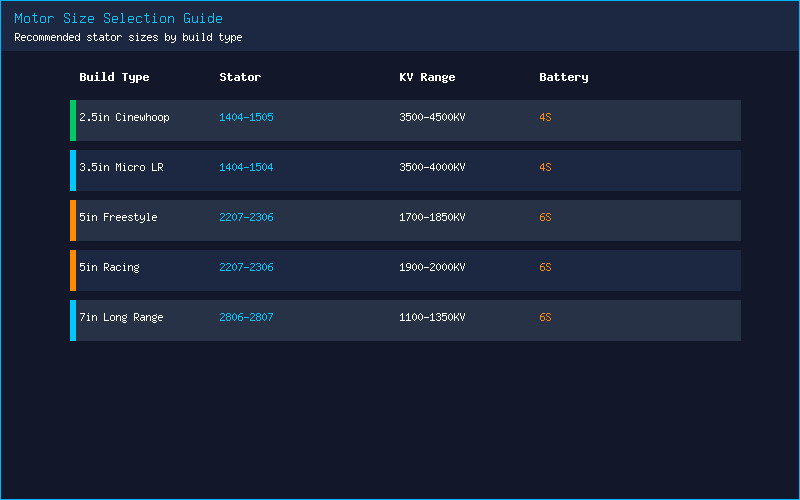
For 5-inch builds: 2207 and 2306 are the gold standards for freestyle. 2207.5 and 2306.5 represent the modern evolution with slightly taller stators for more low-end torque. For 3-3.5 inch builds: 1404, 1504, and 1604 motors balance weight and power. For 7-inch long-range cruisers: 2806.5 and 2807 motors provide the torque needed to spin large, efficient props at low RPM.
KV Rating: The Speed Dial
KV (RPM per Volt) is the most misunderstood motor specification. A 1750KV motor spins at approximately 1750 RPM for every volt applied with no load. Higher KV means higher RPM, which means more speed — but also more current draw, more heat, and shorter flight times. The relationship is not linear; current draw scales with the square of RPM, so doubling KV quadruples no-load current.
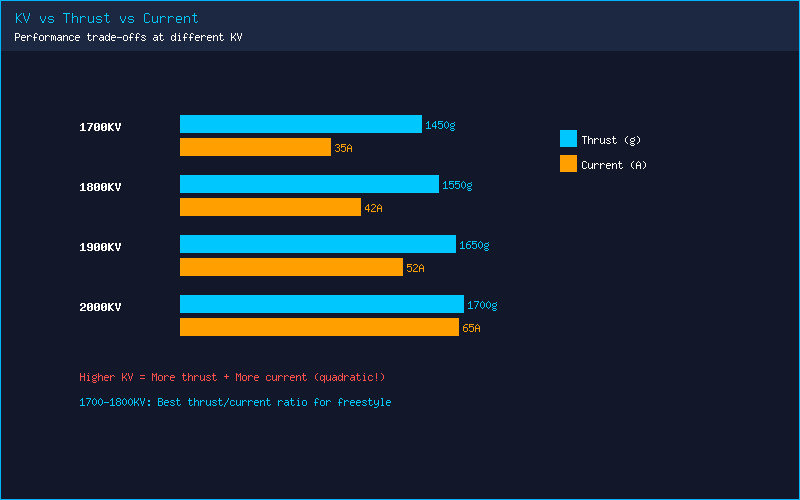
For 5-inch 6S builds (22.2V nominal): 1700-1950KV is the standard range. 1700-1800KV offers the best balance for freestyle with 5-inch props. 1900-2000KV provides more top-end speed at the cost of efficiency and flight time. For 5-inch 4S builds (14.8V): 2300-2700KV compensates for the lower voltage. The gear you should choose: if you fly aggressive freestyle with lots of throttle punches, stay on the lower end of the KV range for more torque and less sag. If you race and need every bit of top speed, push to the higher end.
Thrust-to-Weight: The Only Number That Matters
Thrust-to-weight ratio (TWR) determines how your quad feels in the air. A TWR of 4:1 is the minimum for enjoyable flying — your quad can hover at 25% throttle with room to climb. 8:1 is the sweet spot for freestyle — punchy enough for power loops and Matty flips without being uncontrollable. 12:1 and above is racing territory where throttle management becomes critical.
Calculate your TWR: multiply each motor’s thrust at 100% throttle (from manufacturer data tables) by 4, then divide by your all-up weight including battery. A 5-inch build with T-Motor Velox 2207 1750KV motors producing 1600g each on 6S with 5-inch props: 6400g total thrust / 650g AUW = 9.8:1 TWR. This build will feel explosive but controllable.
Motor Selection by Build Type
5-inch Freestyle: 2207 or 2306, 1700-1850KV on 6S. Look for curved N52SH magnets (better heat tolerance) and Japanese EZO bearings. T-Motor Velox, iFlight XING2, and RCinpower Smoox are proven performers.
3.5-inch Micro Long Range: 1404 or 1504, 3500-4000KV on 4S. Prioritize weight under 10 grams per motor. Flywoo Nin, T-Motor F1404, and RCinpower 1504 are excellent choices.
7-inch Long Range: 2806.5 or 2807, 1100-1350KV on 6S. Torque matters more than peak power — look for motors with broad, flat efficiency curves. BrotherHobby Avenger, T-Motor F90, and iFlight XING 2806.5 dominate this category.
Cinewhoop / 2.5-inch: 1404 or 1505, 3500-4500KV on 4S. Prioritize smoothness and low vibration for clean HD footage. T-Motor Pacer and RCinpower GTS V4 are top performers.
Buy quality motors from reputable brands. Cheap motors with poor balancing produce vibrations that no amount of filtering can fully eliminate. Your motors are the only moving parts on your quad — invest accordingly.
What motors are you running on your main build? What KV did you choose and why? Let us know in the comments!