
Introduction
Long-range FPV flying offers a completely different experience from proximity freestyle. Gliding over mountain ridges, exploring abandoned structures from kilometers away, and capturing cinematic vistas all require careful planning and specialized gear. This guide covers everything you need to build and configure a reliable long-range FPV quad for 2026.
Frame Selection: Why 7-Inch is King
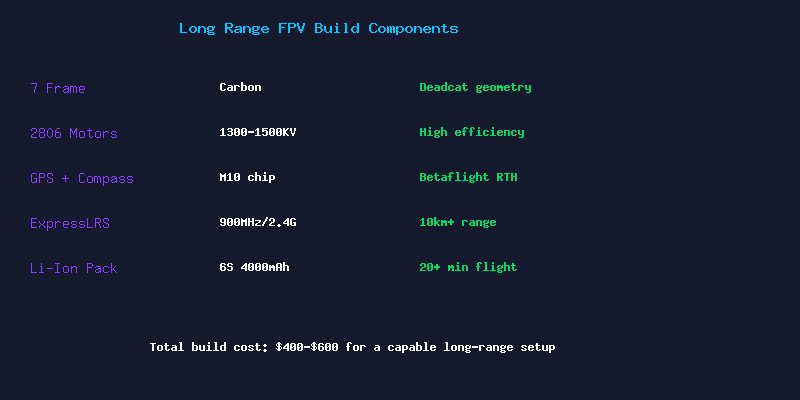
Seven-inch frames offer the ideal balance of efficiency and payload capacity for long-range flight. The larger prop disc area generates more thrust per watt, enabling cruise speeds of 50-70 km/h while drawing only 6-10 amps. Look for frames with:
- Deadcat geometry: Arms swept forward to keep props out of the camera view. Essential for clean HD footage.
- Thick arms (6mm+): Long lever arms experience higher bending forces. Quality frames from GEPRC, iFlight, and FR7 use beefy 6-8mm carbon.
- GPS mounting provisions: Dedicated rear mounting area for GPS/compass module away from VTX and ESC noise.
- Large top plate: Room for Li-Ion packs, HD cameras, and additional electronics.
Motors and Props for Efficiency
Unlike freestyle builds that prioritize peak thrust, long-range builds optimize for efficiency at cruise throttle (30-50%). Select motors in the 2806-2810 stator range with 1100-1500KV for 6S. Lower KV motors paired with high-pitch props (Gemfan 7040 or HQProp 7x4x3) maintain speed at lower RPM, extending flight time. The T-Motor P2810 1100KV paired with 7042 bi-blades can achieve 20+ minutes on a 6S 4000mAh Li-Ion pack.
GPS and Navigation
A reliable GPS module with compass is non-negotiable for long-range. The Holybro M10 Micro (using the u-blox M10 chipset) acquires satellites in under 30 seconds cold start and maintains lock even in challenging environments. Configure Betaflight GPS Rescue with these settings:
- Minimum satellites: 8 (never fly without at least 8 sats locked)
- Altitude increase: 50 meters on failsafe activation
- Climb rate: 500 cm/s for rapid altitude gain
- Return speed: 15 m/s for efficient return
- Angle: 25 degrees for stable climb and return
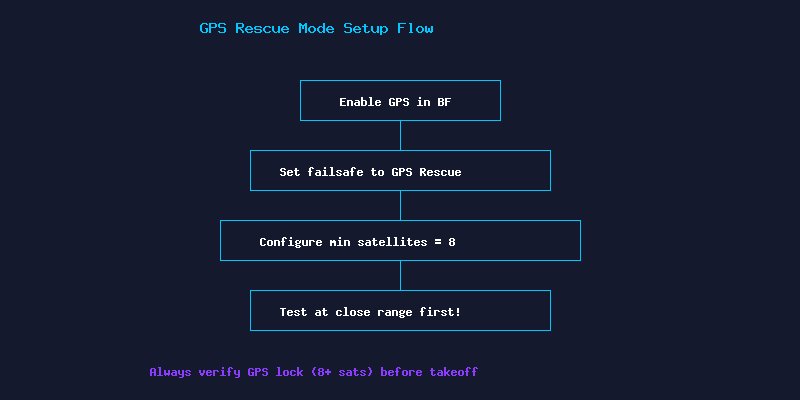
Always test GPS Rescue at close range before attempting long-distance flights. Verify that the quad climbs, turns toward home, and begins returning within 3 seconds of activating the failsafe switch.
Radio Link: ExpressLRS Dominates
ExpressLRS (ELRS) at 900MHz provides the ultimate long-range control link with tested ranges exceeding 30km on just 100mW. The 2.4GHz variant at 250Hz packet rate offers 5-10km range with lower latency, making it suitable for mid-range cinematic flying. Key hardware recommendations:
- Transmitter: RadioMaster Boxer ELRS or TX16S MKII with external ELRS module
- Receiver: HappyModel EP1 (900MHz) or EP2 (2.4GHz) with diversity antennas
- Packet rate: 50Hz for maximum range, 150Hz for balanced range and responsiveness
Video Link for Long Range
Analog on 5.8GHz with a 1.6W VTX and high-gain directional antenna (TrueRC X-Air 5.8 or Pepperbox Extreme) can reach 10-15km with careful antenna tracking. DJI O4 Air Unit and Walksnail Avatar HD both support 1.2W output power and offer cleaner image quality at range. For extreme range (20km+), consider 1.3GHz analog video with a ground station, though this adds significant gear complexity.
Battery Strategy: Li-Ion vs LiPo
Li-Ion packs (typically Samsung 40T or Molicel P42A 21700 cells) store nearly double the energy per gram compared to LiPo. A 6S1P 4000mAh Li-Ion pack weighs ~360g and can sustain 10-15A continuous draw, perfect for efficient cruising. LiPo packs (6S 3300-5000mAh) deliver higher burst current but at 30-50% more weight for equivalent energy. For most long-range builds, Li-Ion is the clear winner.
Safety Checklist
- Set failsafe to GPS Rescue (not Drop)
- Configure minimum battery warning at 3.5V per cell with enough margin to return
- Log GPS coordinates via telemetry to your radio or OSD recording
- Install a self-powered buzzer (VIFLY Finder) for post-crash location
- Check local regulations and airspace restrictions before flying beyond visual line of sight
Conclusion
Long-range FPV is one of the most rewarding disciplines in the hobby. A well-built 7-inch quad with GPS rescue, ExpressLRS, and a Li-Ion pack can explore further than ever before while returning home safely. Start with conservative range limits and gradually extend as you build confidence in your equipment and procedures. The mountains are calling.