
Introduction
Can you 3D print an entire FPV drone frame? The answer is yes — but with important caveats. While carbon fiber remains the gold standard for frame material, 3D printed frames have come a long way thanks to advanced filaments like PETG, ABS, and nylon composites. This guide covers the complete workflow from CAD design to flight testing a 3D printed drone frame.
Designing Your Frame in CAD
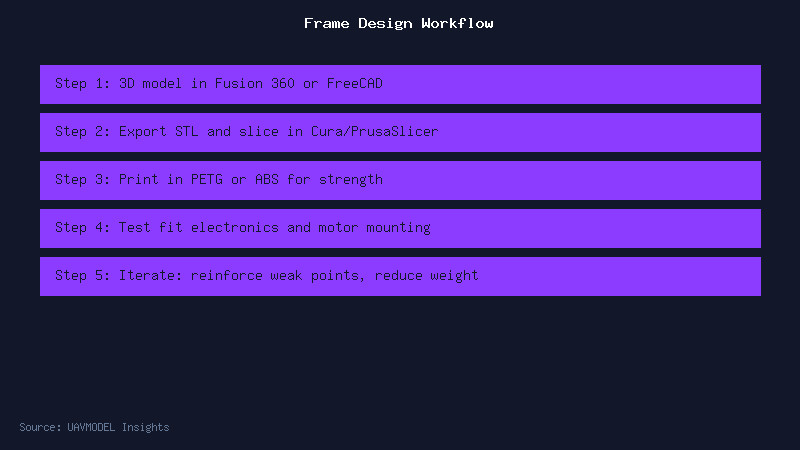
The journey begins in CAD software. Fusion 360 is the most popular choice among FPV designers for its powerful parametric modeling capabilities and free hobbyist license. FreeCAD offers an open-source alternative. Start by modeling the core components — your flight controller stack (30.5×30.5mm), motor mounting pattern (16x16mm or 16x19mm for most 5-inch motors), camera cage dimensions, and VTX antenna mounting point.
Key design principles: keep arm thickness at minimum 6mm for 5-inch builds using PETG, add fillets to all internal corners to reduce stress concentrations, design the frame in modular sections for easy reprinting of damaged parts, and include integrated wire routing channels. The total frame weight should target under 150g for a 5-inch build — heavier than carbon fiber (typically 80-120g) but acceptable for freestyle and cruising.
Material Selection
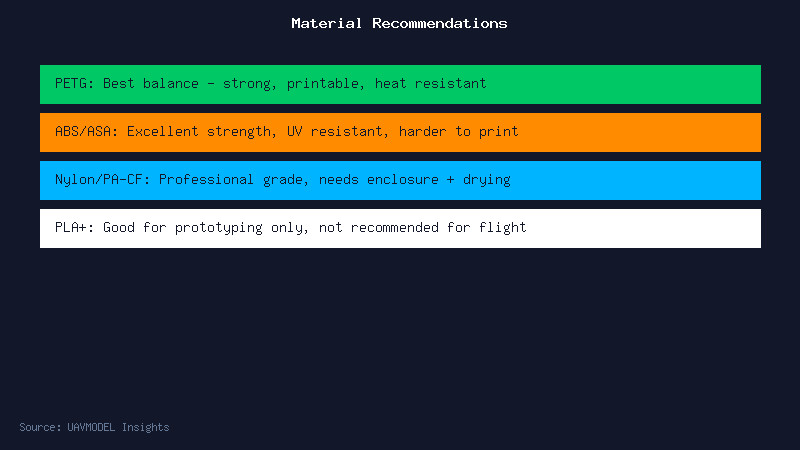
PETG is the best entry-level choice. It offers 70% of the strength of ABS but prints much more easily with minimal warping. PETG has good layer adhesion, moderate flexibility (it bends before breaking), and excellent chemical resistance. Print at 230-250°C nozzle, 80°C bed, with 30% part cooling.
ABS and ASA provide superior strength and temperature resistance compared to PETG. ASA adds UV resistance, making it ideal for frames that will spend time in sunlight. The downside: both require an enclosure to prevent warping and emit fumes during printing. Not recommended without proper ventilation.
Nylon and PA-CF (carbon fiber filled nylon) represent the professional tier. These materials offer strength approaching injection-molded parts. PA-CF is particularly impressive — the carbon fiber additive increases stiffness dramatically while reducing warping. However, nylon absorbs moisture aggressively and must be dried before printing. A hardened steel nozzle is required for abrasive filaments. Expect to pay $40-60 per kilogram.
PLA+ is usable only for prototyping and test-fitting. Do not fly a PLA frame — it will shatter on the first moderate crash.
Print Settings That Matter
For structural drone frames, prioritize strength over aesthetics. Use 4-6 perimeters (walls) rather than relying on infill — perimeters contribute far more to strength than infill percentage. Set infill to 30-50% with a gyroid or cubic pattern for multi-directional strength. Print at the highest temperature your filament allows without degradation to maximize layer adhesion. Orient arms flat on the build plate so layer lines run along the length of the arm — this puts the strongest axis in the direction of maximum stress.
Assembly and Testing
Assemble your printed frame with the same care as a carbon fiber build. Use M3 standoffs for the stack, thread-locking compound on all metal-to-metal fasteners, and soft-mount the flight controller with rubber grommets. Before the first flight, perform a thorough stress test: hold the frame firmly and apply reasonable twisting force to each arm. Listen for cracking sounds and inspect for white stress marks. If it passes, proceed to a low-altitude hover test in grass.
Real-World Performance
Be realistic about expectations. A 3D printed frame will never match the stiffness-to-weight ratio of carbon fiber. You will experience more vibrations (requiring additional filtering in Betaflight), reduced flight time due to extra weight, and lower crash survivability. However, a well-designed PETG frame can survive dozens of light crashes and costs under $5 in materials to reprint. For learning, experimentation, and budget builds, 3D printed frames are absolutely viable.
Conclusion
3D printing a drone frame is an excellent engineering exercise that teaches valuable CAD and materials science skills. While not a replacement for carbon fiber in high-performance applications, printed frames in PETG or nylon composites open up drone building to makers on a budget and enable rapid design iteration. Start with PETG, master your printer settings, and you might be surprised by what you can achieve.