
The Three-Way Battle for Your Face
The FPV goggle market in 2026 has crystallized around three digital HD systems: DJI’s Goggles 3 with the O4 Air Unit ecosystem, Walksnail’s Avatar HD Goggles X, and HDZero’s open-source Goggles with its ultra-low-latency promise. Each system takes a fundamentally different approach to the same problem — getting high-quality video from your quadcopter to your eyes with minimal delay. Choosing between them is the most consequential decision an FPV pilot makes.
DJI Goggles 3 + O4 Air Unit: The Image Quality King
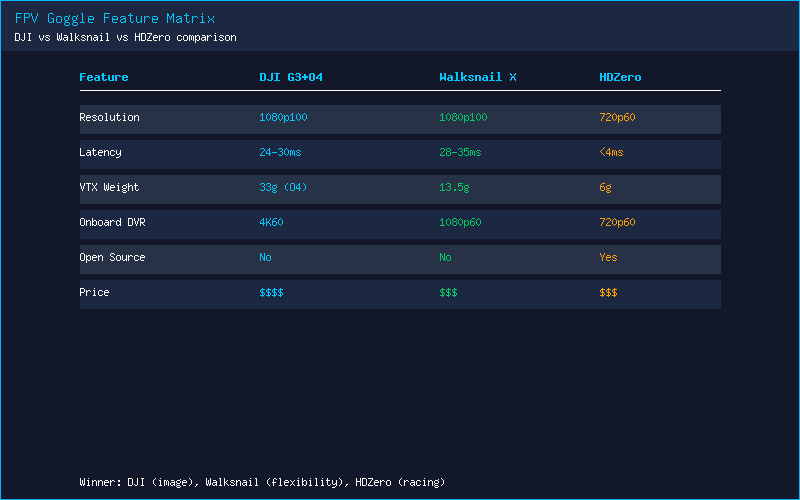
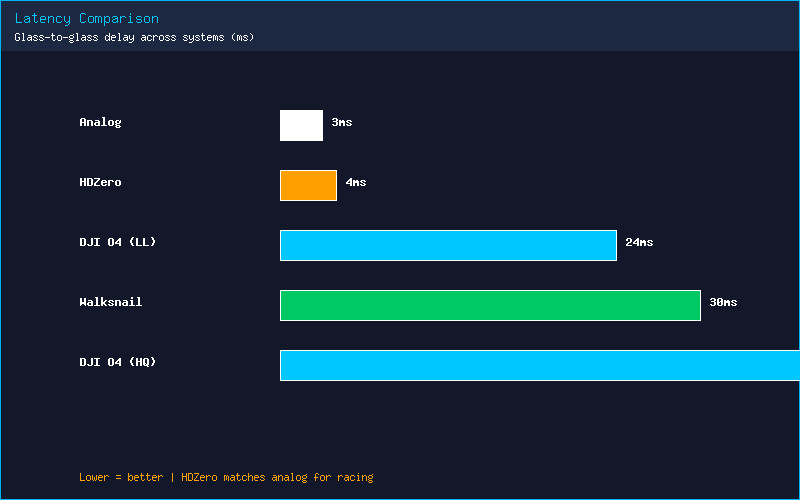
DJI’s Goggles 3 paired with the O4 Air Unit delivers the best image quality in FPV, period. The 1080p 100 fps feed with sub-30 ms glass-to-glass latency is so clean and detailed that it genuinely changes how you fly — you can see individual leaves on trees, power lines before they become a problem, and tiny gaps with confidence. The O4 Air Unit records onboard 4K 60 fps video with RockSteady stabilization, eliminating the need for a GoPro on most builds.
DJI’s ecosystem is also the most polished. The Goggles 3 feature diopter adjustment from -8.0 to +2.0, a comfortable 1920×1080 micro-OLED display per eye, and an integrated battery with 2+ hours of runtime. The OSD provides every metric you need without clutter. The downsides: the O4 Air Unit at 33 grams is heavier than competitors, and DJI’s closed ecosystem means you cannot mix and match components from other manufacturers.
Walksnail Avatar HD Goggles X: The Versatile Contender
Walksnail has aggressively closed the gap with DJI. The Avatar HD Goggles X feature a 1920×1080 micro-OLED display, 100 fps support, and the lightest VTX options in the HD space — the Avatar Nano V3 at just 13.5 grams is nearly half the weight of the O4 Air Unit Lite. Image quality is excellent, with rich colors and sharp detail that approach DJI levels. Latency averages 28-35 ms depending on mode.
Walksnail’s key advantage is flexibility. HDMI input and output let you connect external devices or use the goggles as a spectator screen. The system supports both 1080p and 720p modes with adjustable bitrates. The Avatar HD Pro camera with a 1/1.8-inch sensor handles low light dramatically better than DJI’s O4 camera — critical for dusk flying or indoor warehouse sessions. Walksnail also tends to be 20-30% cheaper than equivalent DJI gear.
HDZero: Latency Above All
HDZero takes the opposite approach from DJI and Walksnail. Instead of compressing video into a buffered stream, HDZero transmits raw uncompressed frames with fixed latency under 4 ms from camera to display. This feels indistinguishable from analog in terms of responsiveness, making HDZero the go-to system for professional racers and pilots who demand absolute timing precision.
The trade-off is image quality. HDZero’s 540p or 720p resolution with visible breakup at range edges cannot match DJI or Walksnail’s polished 1080p feeds. But for racing through tight gates at 100 kph, sub-10 ms latency matters far more than pixel count. HDZero is also fully open-source, with schematics and firmware available for community development. The HDZero Goggles include a deinterlacer and upscaler that make the image look better than raw feed specifications suggest.
Making Your Choice
Choose DJI Goggles 3 + O4 if image quality and onboard recording are your priorities — cinematic pilots, freestyle flyers, and content creators will be happiest here. Choose Walksnail Avatar HD if you want 90% of DJI’s image quality with more flexibility, lighter VTX options for ultralight builds, and a lower price point. Choose HDZero if you race competitively or cannot tolerate any perceptible latency — the sub-4 ms glass-to-glass delay is unmatched. There is no wrong answer in 2026, only the system that best fits your flying style and priorities.
Which goggle system do you fly? Have you switched between systems? Share your perspective below!