
The Filament Decision Every FPV Builder Faces
If you own a 3D printer and fly FPV drones, you have inevitably faced this question: which filament should I use for this part? The three workhorses of FPV 3D printing — TPU, PLA, and PETG — each offer distinct advantages and serious limitations. Making the wrong choice can mean the difference between a part that survives months of crashes and one that disintegrates on the first hard landing.
TPU: The King of FPV Parts
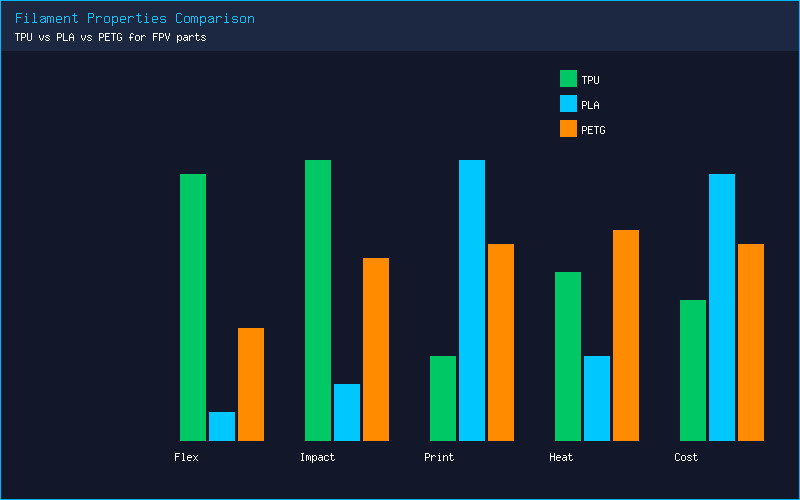
Thermoplastic Polyurethane (TPU) is the undisputed champion for FPV drone components. Its flexibility and impact resistance make it ideal for antenna mounts, GoPro mounts, arm guards, and landing pads. TPU with Shore hardness 95A offers the best balance of rigidity and shock absorption. When you crash, TPU bends and returns to shape instead of cracking — exactly what you want protecting a $400 GoPro or $200 DJI O4 Air Unit.
However, TPU is challenging to print. It requires a direct-drive extruder (Bowden setups struggle), slow print speeds of 20-30 mm/s, and retraction must be disabled or set very low to avoid jamming. Bed adhesion is excellent on PEI sheets, but parts can be difficult to remove. Print temperature ranges from 220-250C with the bed at 40-60C. A hardened nozzle is not required for standard TPU, but abrasive variants like carbon-fiber-filled TPU demand it.
PLA: The Prototyping Workhorse
Polylactic Acid (PLA) is the easiest filament to print and costs half as much as TPU — but it has a fatal flaw for FPV: it is brittle. PLA will crack or shatter on impact, making it unsuitable for any part that experiences crash forces. However, PLA excels for non-structural applications: gimbal protectors, lens caps, prop storage boxes, bench organizers, and mock-up prototypes before committing expensive TPU to a design.
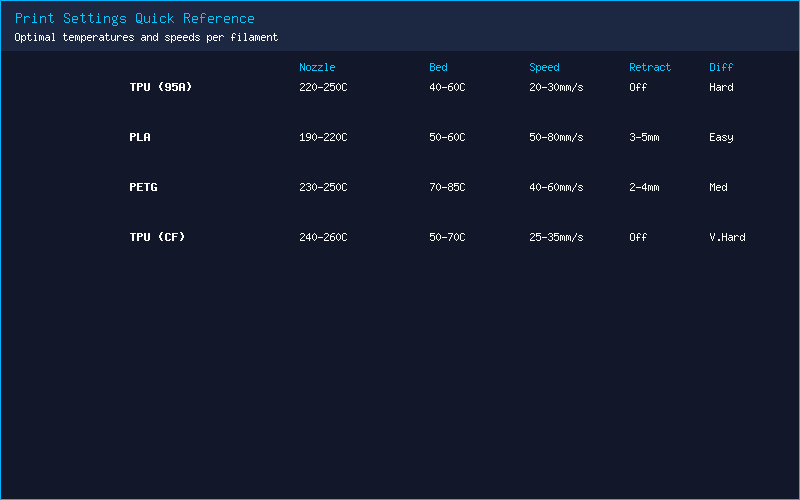
PLA prints beautifully at 190-220C with a bed at 50-60C. It does not require an enclosure and sticks reliably to most build surfaces. For indoor whoop frames or lightweight micro drones that rarely crash hard, PLA+ variants offer improved impact resistance while remaining easy to print. Just never use standard PLA for a GoPro mount on a 5-inch quad — you will learn this lesson the hard way.
PETG: The Middle Ground
Polyethylene Terephthalate Glycol (PETG) sits between TPU and PLA in nearly every category. It is more flexible than PLA but stiffer than TPU, making it suitable for structural mounts that need some give but must hold shape. PETG handles higher temperatures than PLA, so it will not deform inside a hot car on a summer day. It also resists UV degradation better than both TPU and PLA.
PETG prints at 230-250C with a bed at 70-85C. It tends to string more than PLA and adheres aggressively to PEI sheets — use a release agent like glue stick or hairspray to prevent damaging your build plate. For FPV applications, PETG works well for frame spacers, FC mounting adapters, and antenna tubes. It is the pragmatic choice when you need more durability than PLA but cannot justify the printing difficulty or cost of TPU.
Making the Right Choice
Use TPU for anything that protects expensive components or absorbs impact: camera mounts, antenna holders, arm guards, and battery pads. Use PETG for structural pieces that need rigidity and moderate durability: standoffs, FC soft-mounts, and GPS brackets. Use PLA for prototyping, shop tools, and indoor micro components. The extra effort of printing TPU is always worth it for crash-critical parts — your wallet will thank you after the first concrete impact.
What is your go-to filament for FPV parts? Have you tried any exotic materials? Let us know below!