
Introduction
Choosing the right motors is one of the most consequential decisions in an FPV build. Undersized motors overheat and produce sluggish response. Oversized motors add unnecessary weight and drain batteries. This guide explains motor sizing conventions, KV ratings, and thrust-to-weight ratios so you can pick the perfect motors for any build.
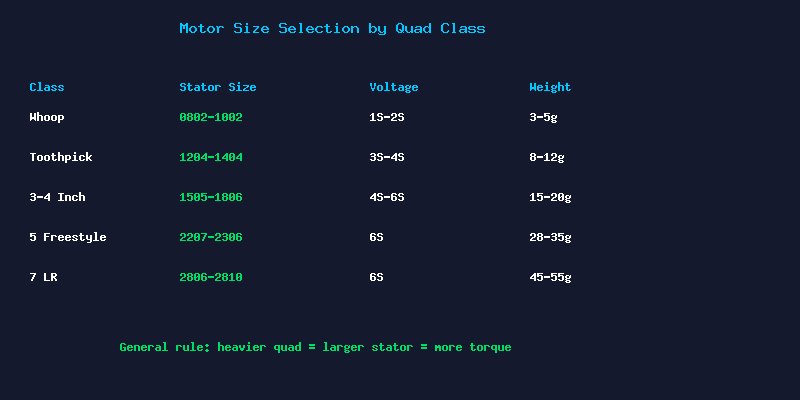
Understanding Motor Naming: What 2207 Means
Brushless motor names follow the format XXXX-YYYY where the first four digits are the stator dimensions (width and height in mm). A 2207 motor has a 22mm diameter stator that is 7mm tall. Wider stators (22xx vs 14xx) produce more torque at lower RPM. Taller stators (xx07 vs xx04) produce more top-end power but spin up slower. For freestyle, 2207 and 2306 are the sweet spot. For racing, 2207.5 and 2306.5 optimize for both torque and top speed.
KV Rating Explained
KV is the theoretical RPM per volt with no load. A 1900KV motor on 6S (25.2V) would spin at 47,880 RPM unloaded. Higher KV means more RPM but less torque. For 5-inch 6S builds, 1700-1950KV is standard. For 4S, 2400-2700KV compensates for the lower voltage. Important: KV requirements drop as voltage increases. A motor designed for 4S at 2450KV will pull excessive current and overheat on 6S.
Thrust-to-Weight Ratio: The Critical Metric
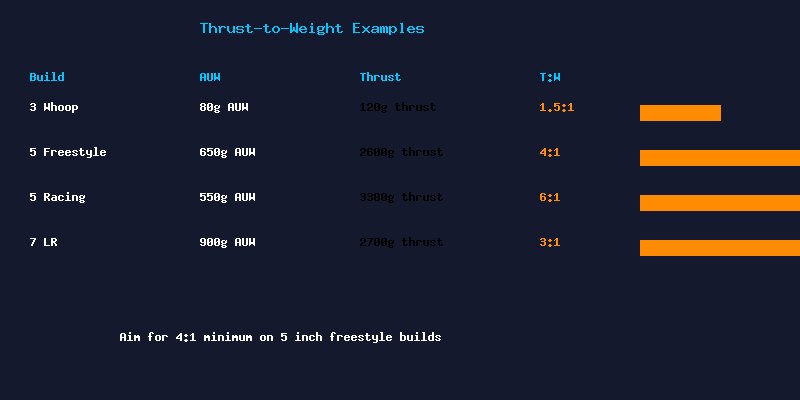
Thrust-to-weight (TWR) determines how your quad feels in the air:
- 2:1-3:1: Cruising and long-range. Gentle, efficient flight with long battery life.
- 4:1-5:1: Freestyle sweet spot. Plenty of punch for power loops and Matty flips while keeping the quad controllable.
- 6:1-8:1: Racing and aggressive freestyle. Explosive acceleration but twitchy handling that demands fast reflexes.
- 10:1+: Competition-level performance. Requires top-tier batteries and carefully tuned PIDs.
Propeller Matching
Motor and propeller selection go hand in hand. For 5-inch builds with 2207 motors, standard prop pitches range from 4.3 to 5.1 inches. Higher pitch props (51466) produce more thrust at the cost of efficiency and increased motor temperature. Lower pitch (5130) trades peak thrust for smoother low-end control. For 3.5-inch builds with 1505 motors, 3520 tri-blades are the standard.
Recommended Motors by Build Type
- Micro Whoop (1S-2S): Happymodel EX0802 25000KV or Rcinpower 1002 22000KV. Lightweight, efficient, and crash-resistant.
- 3.5-Inch Sub-250g: T-Motor P1604 2850KV or Xing 1506 3000KV. Excellent efficiency for 4S setups.
- 5-Inch Freestyle: iFlight Xing2 2207 1850KV or T-Motor Velox V3 2306 1950KV. The industry benchmarks for power and durability.
- 5-Inch Racing: Rcinpower Smoox 2306.5 1880KV or T-Motor F60 PRO V 2208 1950KV. Lightweight and aggressive.
- 7-Inch Long Range: BrotherHobby Avenger 2806.5 1300KV or T-Motor P2810 1100KV. Torque-focused for efficiency with large props.
Motor Maintenance Tips
After every major crash, check for bent motor bells by spinning the motor by hand and looking for wobble. Listen for grinding bearings — replace them early to prevent magnet damage. Use Loctite 243 (blue) on motor screws but keep it away from bearings and windings. A drop of light machine oil on bearings every 20-30 flights extends motor life significantly.
Conclusion
Motor selection comes down to matching stator size to your frame size and KV to your battery voltage. For most 5-inch freestyle pilots, a set of 2207 1850-1950KV motors on 6S provides the ideal balance of power, efficiency, and durability. Start with reputable brands (T-Motor, iFlight, Rcinpower, BrotherHobby) and you will rarely be disappointed.