
Introduction
3D printing has revolutionized the FPV drone hobby. Instead of waiting weeks for replacement parts or paying premium prices for specialized mounts, you can now print exactly what you need in hours. From GoPro mounts to antenna holders, GPS brackets to arm guards — a 3D printer is one of the most valuable tools an FPV pilot can own.
Why 3D Print FPV Parts?
Cost savings: A GoPro TPU mount costs $5-15 to buy. You can print one for about $0.30 worth of filament. Over a season of flying, the printer pays for itself.
Customization: Need a mount that holds both an action camera AND a GPS module at a specific angle? Download a model, modify it in TinkerCAD or Fusion 360, and print it. Mass-produced parts can’t match custom-fit solutions.
Rapid replacement: Break an arm guard during a Saturday session? Print a replacement and have it ready by Sunday morning. No shipping delays, no waiting.
Prototyping: Before committing to an expensive carbon fiber design, you can print and test concepts in plastic. This is how many frame designs are developed.
Best Filaments for FPV Parts
TPU (Thermoplastic Polyurethane)
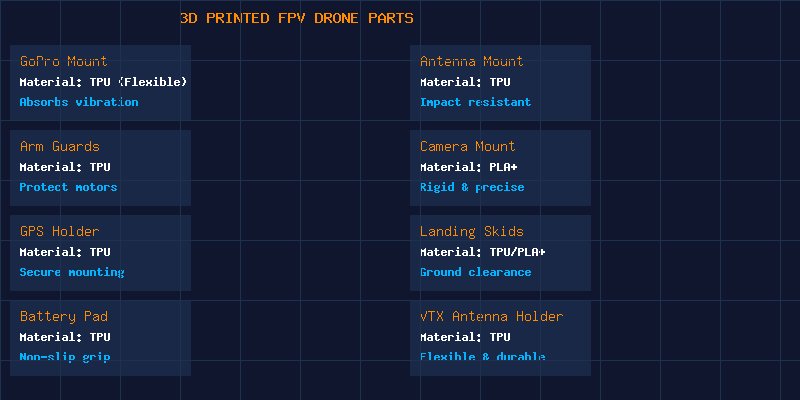
This is the king of FPV 3D printing. TPU is flexible, impact-resistant, and absorbs vibration. It’s perfect for:
- GoPro and action camera mounts (the flexibility acts as vibration dampening)
- Antenna mounts (bends instead of breaking in crashes)
- Arm guards and skid plates (absorbs impact energy)
- Battery pads and grip surfaces
- GPS and buzzer holders
Print TPU at 220-240°C with a heated bed at 40-60°C. Use slow print speeds (20-30mm/s) and disable retraction if you have stringing issues. A direct-drive extruder is strongly recommended — Bowden setups struggle with flexible filaments.
PLA+ and PETG
For rigid parts that need precision:
- PLA+: Good for camera mounts that need exact positioning. Stiffer than TPU but more brittle. Use for indoor and light-duty parts.
- PETG: A great middle ground — stronger than PLA, easier to print than TPU. Good for structural brackets and internal mounts.
ABS and Nylon
For advanced users. ABS offers good impact resistance and can be vapor-smoothed, but it warps easily and requires an enclosure. Nylon is incredibly tough but requires high temperatures and dry filament storage.
Design Considerations for FPV Parts
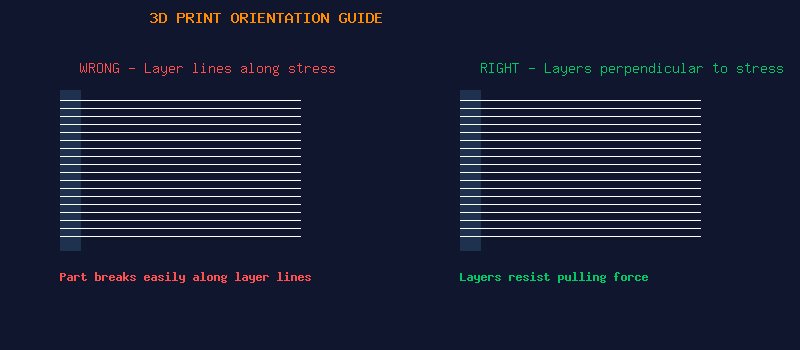
Layer orientation matters: Parts fail along layer lines. Orient your print so that layers run perpendicular to the expected stress. A GoPro mount that flexes forward/backward should have layers running side-to-side, not front-to-back.
Infill strategy: For TPU parts, 20-40% gyroid infill provides excellent impact absorption. For PLA structural parts, 50-70% infill with 3-4 perimeters gives the strength needed.
Weight optimization: Every gram matters on a drone. Use lightning or support cubic infill patterns to save weight. A TPU GoPro mount can be as light as 8-10g when properly optimized.
Tolerances: TPU shrinks slightly. For press-fit parts, add 0.2-0.3mm clearance. Always print a test fit before committing to a long print.
Essential FPV Parts to Print
- GoPro/action camera mount — The most printed FPV part. Look for designs with built-in vibration dampening.
- Antenna mounts — Keep your VTX and receiver antennas at the optimal 45-degree angle.
- Arm guards — Protect motor wires and arms from prop strikes and ground contact.
- GPS/compass holder — Securely mount GPS modules away from interference sources.
- Landing skids — Keep your battery and bottom plate off the ground.
- Battery strap channels — Prevent battery straps from sliding on the bottom plate.
- VTX and RX holders — Immobilize your electronics to prevent vibration damage.
Recommended 3D Printers for FPV
Budget: Bambu Lab A1 Mini ($299) — Incredible print quality out of the box, great for TPU with its direct drive. The smaller build volume is fine for FPV parts.
Mid-range: Bambu Lab P1S ($699) — Enclosed, handles ABS and Nylon, larger build volume. The best all-around choice.
Enthusiast: Prusa MK4 ($799) — Legendary reliability, excellent TPU performance, open-source ethos.
Conclusion
A 3D printer is no longer a luxury for FPV pilots — it’s practically essential. The ability to print custom TPU mounts, replace broken parts overnight, and prototype new designs transforms how you approach building and repairing drones. Start with a roll of TPU and a GoPro mount file from Thingiverse or Printables. You’ll be amazed at what you can create.