
Introduction
Motor KV rating is one of the most misunderstood specifications in FPV drone building. Many pilots think “higher KV = faster” and leave it at that, but the reality is far more nuanced. Your motor KV choice affects everything from flight time to throttle response, and getting it wrong can lead to burned motors, puffed batteries, or simply poor performance.
What Does KV Actually Mean?
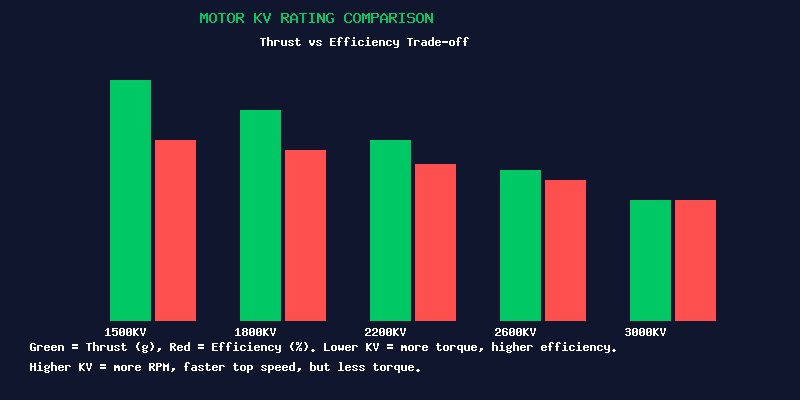
KV stands for “RPM per Volt” — specifically, the number of revolutions per minute the motor will spin (with no load) for each volt applied. A 2000KV motor on a 4S battery (16.8V fully charged) would theoretically spin at 33,600 RPM under no load. In reality, the actual RPM is lower due to aerodynamic drag, friction, and electrical losses.
Important distinction: KV is NOT a measure of power. It describes the motor’s speed constant. A higher KV motor spins faster per volt but produces less torque. A lower KV motor spins slower but generates more torque. Think of it like bicycle gears: high KV is like a high gear (fast but hard to pedal), low KV is like a low gear (slower but easier to pedal).
How Battery Voltage Affects Your KV Choice
This is where many beginners go wrong. You can’t choose a KV rating without also deciding on your battery voltage. Here’s why:
- 4S (16.8V) with 2300-2700KV: Classic setup. Snappy response, ~30,000-38,000 RPM range. Great for freestyle and racing with 5-inch props.
- 6S (25.2V) with 1700-1950KV: Modern standard. Similar final RPM to 4S/2500KV but with more torque and efficiency. Less current draw means cooler running motors and ESCs.
- 6S with 2200+KV: Extremely high RPM. Only for very light props or speed runs. Risks overheating motors and exceeding ESC current limits.
- 2S-3S with 4000-8000KV: Micro and whoop-class drones using tiny props.
The formula to remember: Target RPM = KV × Voltage × Efficiency Factor (~0.85)
For 5-inch props, optimal RPM is roughly 28,000-35,000 at hover throttle. Much above 40,000 RPM and the props start cavitating and losing efficiency dramatically.
Understanding Motor Stator Size
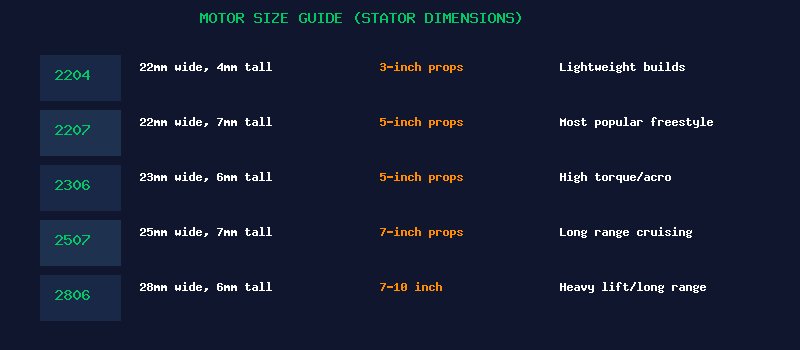
Motor names like “2207” or “2306” describe the stator dimensions: the first two digits are the stator width in mm, and the last two are the stator height. Wider stators produce more torque. Taller stators (longer magnets) produce more power at the top end.
- 2204 – 2205: Lightweight builds, 3-4 inch props. Quick response, less torque.
- 2207: The sweet spot for 5-inch freestyle. Good balance of torque and responsiveness.
- 2306: High torque, excellent for heavy 5-inch builds. Popular for 6S freestyle.
- 2507 – 2508: 7-inch long-range builds. More torque for spinning larger props efficiently.
- 2806 – 2810: 7-10 inch builds, heavy lift, extreme long range.
KV Selection Guide by Build Type
Racing (5-inch, 4S): 2400-2700KV with 2207 or 2306 motors. You want maximum top-end RPM for straight-line speed. Expect short flight times (2-3 minutes) and hot motors.
Freestyle (5-inch, 6S): 1700-1900KV with 2207 or 2306 motors. The modern 6S standard provides amazing throttle resolution and efficiency. You get the same final RPM as 4S/2500KV but with less current draw.
Long Range (7-inch, 6S): 1300-1700KV with 2507-2806 motors. Lower KV means more torque for spinning those larger 7-inch props efficiently. Flight times of 15-25 minutes are achievable.
Cinewhoop (3-inch, 6S): 2800-3600KV. Ducted designs need higher RPM to overcome the efficiency loss from ducts.
Common KV Mistakes
- Too high KV on heavy props: Motor draws excessive current trying to spin a heavy prop. Results in heat, voltage sag, and possible motor burnout.
- Too low KV on light props: Motor never reaches its power band. Feels sluggish and unresponsive.
- Mixing KV between motors: All four motors must be identical KV. Mismatched KV causes constant corrections from the flight controller, reducing efficiency and flight quality.
Conclusion
For most 5-inch pilots in 2026, a 2207 or 2306 motor in the 1700-1900KV range on 6S is the sweet spot. You get excellent power, good efficiency, and the modern Betaflight ecosystem is optimized around this configuration. If you’re still on 4S, 2400-2600KV remains a solid choice. Remember: KV is just one piece of the puzzle — always consider your prop size, battery voltage, and flying style together.