
Introduction
ExpressLRS (ELRS) has revolutionized FPV radio control since its release, offering unprecedented range, ultra-low latency, and an open-source ecosystem at budget-friendly prices. But ELRS comes in two frequency flavors: 2.4GHz and 900MHz. Choosing between them is one of the most important decisions when building a new quad. This guide compares both protocols across range, latency, penetration, antenna size, and real-world performance to help you pick the right one for your flying style.
The Physics: Why Frequency Matters
Radio waves at different frequencies behave differently in the real world. Lower frequencies (longer wavelengths) diffract better around obstacles, penetrate through foliage and buildings more effectively, and experience less free-space path loss over distance. This is basic physics — a 900MHz signal at 33cm wavelength simply bends around a tree that would block a 2.4GHz signal at 12.5cm wavelength.
At a given distance, 900MHz experiences approximately 8.5dB less free-space path loss than 2.4GHz. That is a factor of roughly 7x in linear power terms. This means a 100mW 900MHz transmitter will reach roughly the same distance as a 700mW 2.4GHz transmitter, all else being equal. The practical upshot: 900MHz offers dramatically more range and penetration for the same transmitter power and antenna setup.
However, higher frequencies offer benefits too. 2.4GHz supports much higher data rates, allowing faster packet rates. The smaller wavelength means smaller antennas — a 2.4GHz dipole is about 31mm per element versus 83mm for 900MHz. And 2.4GHz operates in a globally unlicensed ISM band, while 900MHz (868MHz in Europe, 915MHz in Americas) falls into different regulatory frameworks.
Range: How Far Can You Really Go?
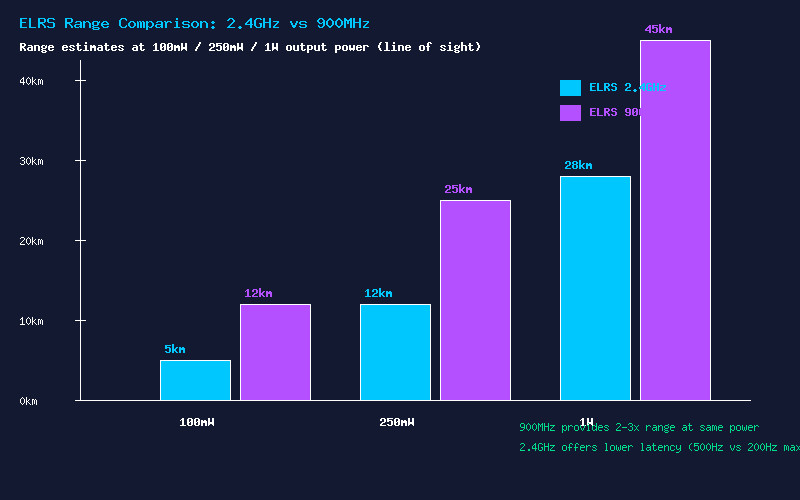
In real-world testing with standard hardware (ceramic tower antenna on TX, T-antenna on RX), here are the approximate reliable ranges at 100Hz packet rate, 100mW dynamic power, line of sight:
- ELRS 2.4GHz, 100mW: 3-8km (telemetry lost at 5-6km typically)
- ELRS 2.4GHz, 1W: 15-30km (pushing the limits with directional TX antenna)
- ELRS 900MHz, 100mW: 8-15km (solid telemetry at 10km)
- ELRS 900MHz, 1W: 30-50km+ (the limiting factor becomes video link)
These numbers assume clean line of sight. Add trees, buildings, or terrain, and 900MHz pulls ahead even more dramatically. In a dense forest environment, 900MHz at 250mW may outperform 2.4GHz at 1W due to superior penetration.
Latency and Packet Rate: The Racing Edge
Latency is where 2.4GHz shines. ELRS 2.4GHz supports packet rates up to 500Hz in FLRC mode and 1000Hz in development firmware, with latency as low as 2-3ms over the air. For comparison, ELRS 900MHz maxes out at 200Hz with approximately 5ms latency. Here is how the packet rates break down:
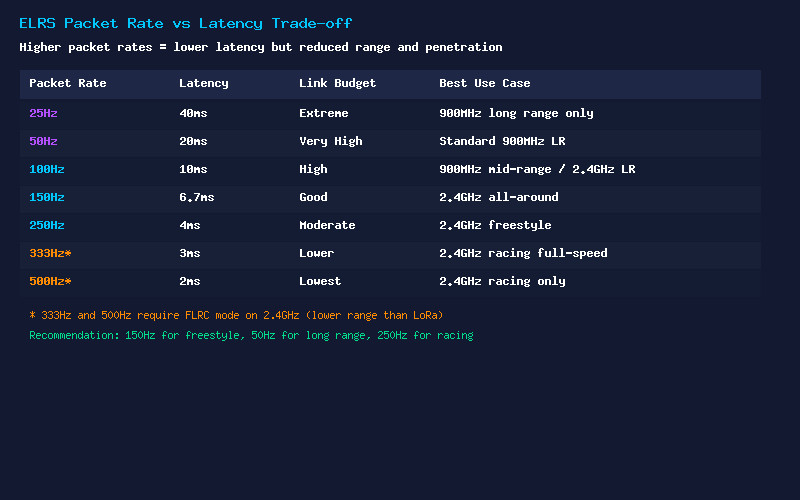
- 25-50Hz: Available on both 2.4GHz and 900MHz. Extremely long range, telemetry-heavy. Latency 20-40ms. Ideal for fixed-wing long range where sub-second control latency is acceptable.
- 100-150Hz: The sweet spot for most pilots. Latency 6-10ms. Excellent range on both bands with good telemetry. 150Hz on 2.4GHz is the most popular ELRS configuration worldwide.
- 250Hz: 2.4GHz only. Latency 4ms. Reduced range but still 5km+ with 1W. The standard for freestyle pilots who want responsive feel.
- 333-500Hz: 2.4GHz FLRC mode. Latency 2-3ms. Significantly reduced range (1-3km) and no telemetry. Racing-only mode where every millisecond counts.
For 99% of pilots, the latency difference between 150Hz 2.4GHz (6.7ms) and 50Hz 900MHz (20ms) is imperceptible in flight. The human reaction time is 150-250ms, and the total system latency includes camera processing (10-30ms), VTX encoding (5-20ms), and goggle display (5-15ms). The 13ms radio link difference is a small fraction of the total pipeline.
Hardware, Antennas, and Installation
2.4GHz hardware is significantly smaller and lighter. A typical 2.4GHz receiver weighs 0.4-1.0g and measures 10x12mm. The ceramic tower antenna built into many receivers (Radiomaster RP1, Happymodel EP1) eliminates external antennas entirely, creating the cleanest possible build. External T-antennas are small and easy to mount on any frame.
900MHz hardware is larger. Receivers weigh 1.5-3.0g and measure 14x20mm. The antennas are physically large — an Immortal-T at 900MHz is 160mm from tip to tip, which can be challenging to mount cleanly on a 3-inch quad. On a 7-inch long-range build, the antenna size is a non-issue.
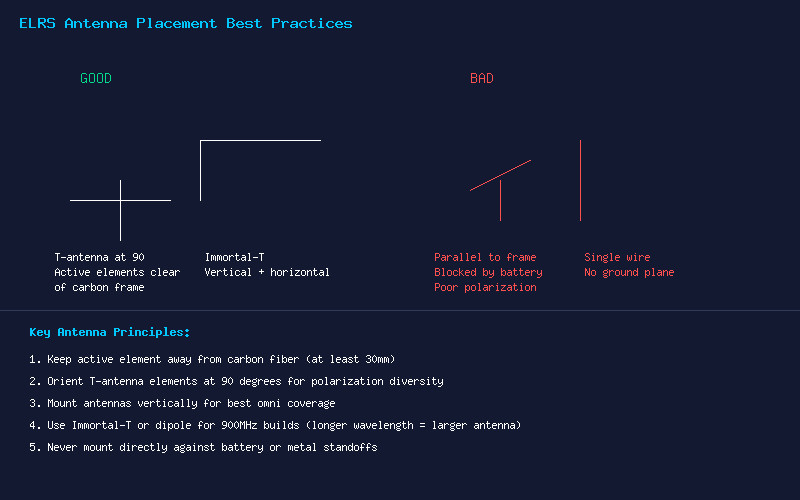
Antenna placement rules (both bands):
- Keep the active element at least 30mm from any carbon fiber. Carbon is conductive and will detune your antenna.
- Orient the two T-antenna elements at 90 degrees to each other. This provides polarization diversity, so you maintain signal regardless of quad orientation.
- Mount antennas vertically whenever possible. The null of a dipole antenna points directly out the tip — if both your TX and RX antennas are vertical, you avoid nulls during level flight.
- Never zip-tie an antenna directly against a metal standoff or battery. Both will absorb and reflect RF energy.
- For 900MHz builds, consider a dipole antenna with a proper ground plane rather than a simple monopole. The longer wavelength makes ground plane effects more significant.
When to Choose 2.4GHz
Choose ELRS 2.4GHz if:
- You fly racing or aggressive freestyle and want maximum packet rate
- You build sub-250g quads where every gram counts
- You want the simplest possible build with no external antennas
- You fly primarily within 2-3km range
- You fly in an area with crowded 900MHz spectrum (LoRa WAN, ISM band congestion)
- Your flying buddies all use 2.4GHz and you want easy compatibility
When to Choose 900MHz
Choose ELRS 900MHz if:
- You fly long range (5km+) and need rock-solid link beyond visual line of sight
- You fly in areas with heavy foliage, buildings, or terrain obstructions
- You fly fixed-wing FPV where antenna size is less of a constraint
- You want the maximum possible link budget for peace of mind
- You fly in areas with extreme 2.4GHz interference (WiFi-heavy urban environments)
- You want telemetry at extreme distances for GPS coordinate tracking
Dual-Band: The Best of Both Worlds
Many pilots now run a dual-band ELRS setup. The Radiomaster Ranger series and several other modules support both 2.4GHz and 900MHz from the same TX module. You can fly a 2.4GHz receiver on your racing quad and a 900MHz receiver on your long-range cruiser, switching between them with a simple model change on your radio. This hybrid approach gives you the ideal protocol for every flying scenario without committing to one ecosystem.
Conclusion
The 2.4GHz vs 900MHz decision ultimately depends on your priorities. If latency and compact hardware matter most, 2.4GHz is the clear winner. If range and penetration are your primary concerns, 900MHz is unmatched. For most pilots building their first ELRS quad, 2.4GHz at 150-250Hz is the right starting point — it offers more than enough range for typical flying (5-10km), excellent latency, and the widest hardware selection. Add a 900MHz module later when you inevitably catch the long-range bug.