
Introduction
FPV drone motors are the heart of your quadcopter. While many pilots focus on frame design and flight controllers, motor selection is arguably the most critical decision affecting flight performance. Understanding stator size, KV ratings, and the relationship between motor specs and real-world thrust will help you build better drones. This guide breaks down the science behind brushless motors in plain language.
Stator Size: The Foundation of Motor Power
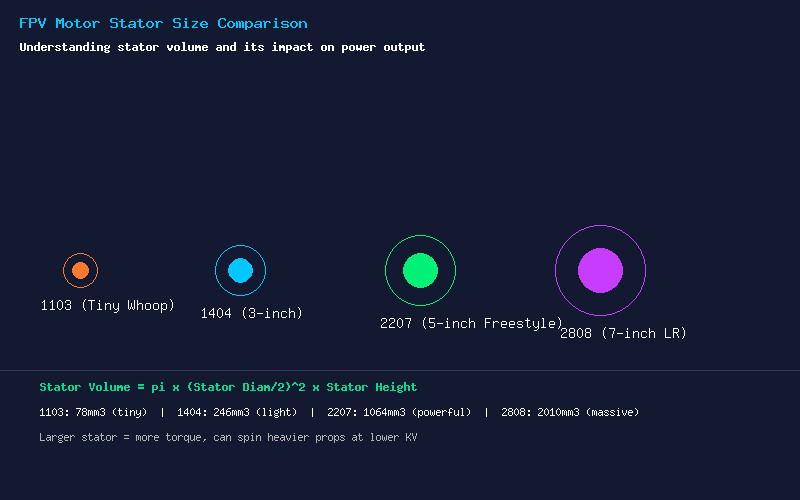
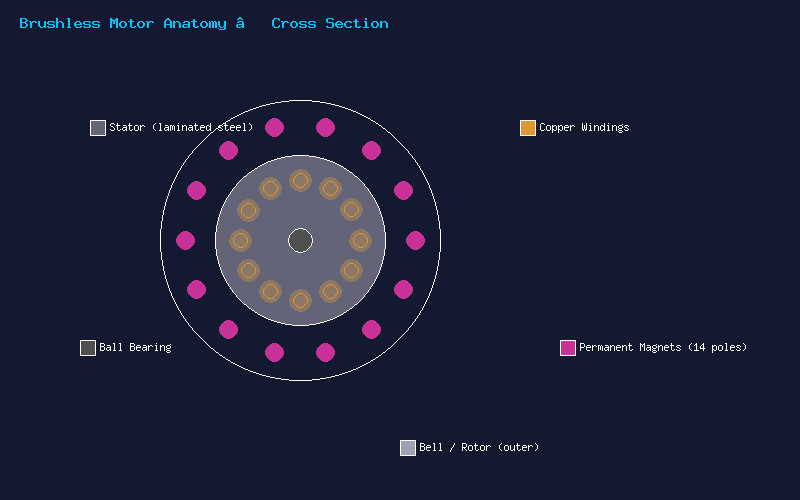
The stator is the stationary part of the motor containing copper windings around laminated steel teeth. Stator dimensions are expressed as two numbers — for example, 2207 means a stator diameter of 22mm and a stator height of 7mm. Stator volume (approximately pi times radius squared times height) is the single best predictor of a motor’s torque capability.
Common stator sizes and their applications:
- 1102-1105: Tiny whoops and 1.6-2 inch micros. Stator volume 19-48mm. Ideal for indoor flying, weigh 3-5g each.
- 1204-1404: 2.5-3 inch ultralight builds. Stator volume 45-246mm. The sweet spot for sub-250g outdoor quads, 5-9g each.
- 1507-2004: 3-4 inch cinewhoops and toothpicks. Stator volume 124-571mm. Good balance of power and efficiency, 10-18g each.
- 2207-2306: 5-inch freestyle. Stator volume 798-1064mm. The most popular size in FPV, handling 5-6 inch props with authority, 25-32g each.
- 2508-2810: 7-inch long range cruisers. Stator volume 1227-2010mm. Massive torque for efficient cruising with heavy Li-Ion packs, 40-55g each.
Larger stator volume means more iron in the magnetic circuit, more copper in the windings, and ultimately more torque. A 2207 motor can swing a 5-inch prop at 30 degrees of pitch without breaking a sweat — try that on a 1404 and you will smoke the windings in seconds.
KV Rating: The Speed Constant Demystified
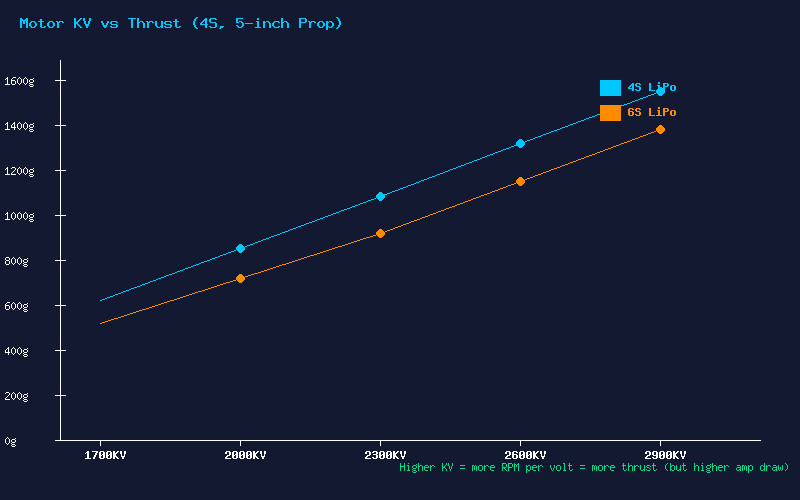
KV is the most misunderstood specification in FPV motors. KV stands for “RPM per Volt” — a 2400KV motor on a fully charged 4S battery (16.8V) will try to spin at approximately 40,320 RPM with no load. The critical nuance: KV tells you the unloaded speed, not the power. A 2400KV 1103 motor and a 2400KV 2207 motor have the same unloaded RPM, but the 2207 produces dramatically more torque and can maintain that RPM under load.
KV selection guidelines by build type:
- Low KV (1700-2000): 6S 5-inch freestyle, 4S 7-inch long range. High torque, lower RPM, excellent efficiency.
- Medium KV (2200-2600): 4S 5-inch freestyle, 6S 3-inch speed builds. The most common range, good balance of power and control.
- High KV (2800-3800): 4S 3-inch, 3S ultralights. High RPM for small props that need speed to generate thrust.
- Very High KV (4000-8000): 1S-2S tiny whoops and micros. Spinning tiny 31mm-40mm props requires extreme RPM.
The KV-Torque Tradeoff
Here is the relationship that confuses many pilots: for the same stator size, higher KV motors produce less torque per amp but more RPM per volt. This means a 1700KV motor on 6S and a 2550KV motor on 4S can produce similar total power — the 6S setup delivers it through higher voltage (and lower current), while the 4S setup delivers it through higher current (and higher KV).
The 6S advantage is primarily in efficiency: higher voltage means lower current for the same power, which means less resistive heating in the ESCs, wires, and battery. A 6S 5-inch build running 1700KV motors will typically run 10-15C cooler than an equivalent 4S 2550KV build pushing the same prop at the same RPM. The cost is a slight weight penalty and the need for 6S-compatible electronics.
Motor Construction and Quality Markers
A well-built brushless motor contains several quality indicators that affect performance and longevity:
Magnets: N52SH or N52UH grade neodymium magnets are the standard for premium FPV motors. The “SH” and “UH” suffixes indicate the maximum operating temperature before demagnetization (150C and 180C respectively). Cheaper motors use lower-grade N35 or N38 magnets that lose strength at lower temperatures.
Stator steel: Quality motors use 0.15mm or 0.20mm thick laminations. Thinner laminations reduce eddy current losses, improving efficiency at high RPM. Budget motors often use 0.35mm laminations that waste more energy as heat.
Windings: Single-strand windings (one thick copper wire per tooth) are more efficient than multi-strand windings because they pack more copper into the same slot area. Premium motors from brands like T-Motor, RCinpower, and iFlight use single-strand winding techniques.
Bearings: Japanese EZO or NMB bearings are the gold standard. Chinese no-name bearings may feel smooth initially but develop slop after 20-30 flight hours. Listen for grinding or rough rotation — it is the first sign of bearing failure.
Bell and shaft: Titanium alloy shafts are lighter and stronger than stainless steel. Hollow shafts save 1-2g per motor and improve cooling by allowing airflow through the motor center.
Matching Motors to Props and Flying Style
The motor-prop combination determines your quad’s personality. Here are proven pairings:
- Racing (5-inch): 2207 2500-2700KV with 5×4.3×3 or 5×4.5×3 props. Focus on top-end speed and quick response. These setups pull 35-45A per motor at full throttle.
- Freestyle (5-inch): 2306 1700-1950KV (6S) with 5×4.3×3 props. Focus on low-end torque for quick recovery from dives and punch-outs. Smooth throttle feel with 25-35A peak draw.
- Cinewhoop (3.5-inch): 2004 2900-3200KV with 3.5×2.5×3 props. Efficient cruising with enough punch for smooth cinematic maneuvers, 12-18A peak.
- Long Range (7-inch): 2807 1300-1500KV with 7×3.5×2 bi-blade props. Maximum efficiency for 20+ minute flights, cruising at 4-6A per motor.
Motor Maintenance and Troubleshooting
Keep your motors healthy with these practices:
- After every crash: Spin each motor by hand, feeling for grit or resistance. Check for bent bells by looking at the air gap between bell and stator — it should be perfectly even.
- Every 50 flights: Apply one drop of lightweight bearing oil (Scorpion Motor Oil or Tri-Flow) to the top and bottom bearings. Do not over-lubricate — excess oil attracts dirt.
- Replace bearings at first sign of noise: Running worn bearings damages the stator and magnets. Quality replacement bearings cost $3-5 per motor and take 10 minutes to swap.
- Check motor screws: Screws that are too long will contact the windings and short the motor. Your motor screws should not protrude more than 2-3mm past the frame arm.
Conclusion
Motor science does not require an engineering degree — just an understanding of the key relationships between stator volume, KV, voltage, and prop load. Match your motor size to your prop size, your KV to your battery voltage, and invest in quality construction with good magnets and bearings. A well-chosen motor setup will deliver hundreds of flights of reliable, thrilling performance.