
The Promise and Reality of 3D Printed Frames
The idea is seductive: download an STL file, hit print, and a few hours later you have a complete FPV drone frame for pennies in filament. When you inevitably crash and break an arm, you simply print a replacement instead of waiting a week for shipping from China. A 3D printed drone frame promises the ultimate in rapid iteration and repairability. But does it actually fly? And more importantly, does it survive?
Material Science Meets Flight Dynamics
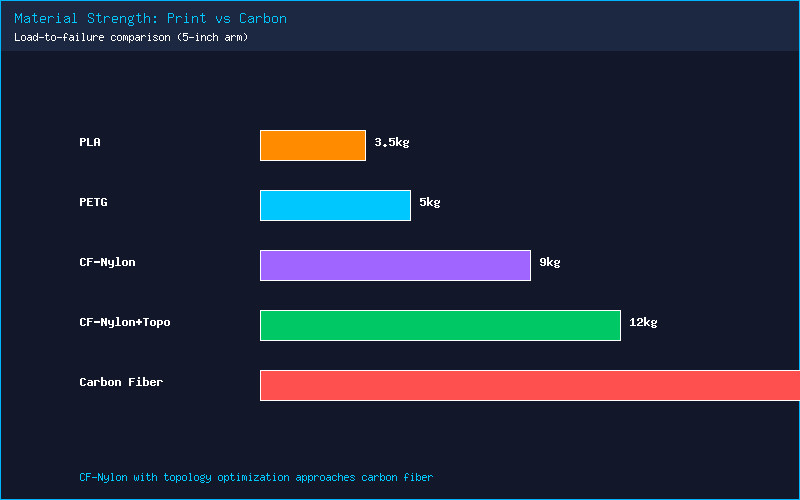
Carbon fiber is the gold standard for FPV frames because it achieves extraordinary stiffness-to-weight ratios. A typical 5-inch carbon fiber arm weighing 8 grams can support over 15 kilograms before failing. Compare that to a PLA printed arm of identical dimensions: it weighs 10-12 grams and fails at 3-4 kilograms. Even carbon-fiber-filled PETG or nylon struggles to reach half the strength of woven carbon fiber sheet.
However, 3D printed frames have one advantage carbon fiber lacks: geometric freedom. A printed arm can incorporate internal lattices, variable wall thickness, and organic curves that concentrate material where stress is highest. Topology optimization software can generate arm shapes that are 30-40% stronger than simple rectangular extrusions while using the same amount of material. When you combine optimized geometry with advanced filaments like Polymaker Fiberon PA6-CF20 (carbon-fiber-filled nylon), the gap narrows considerably.
The Vibration Problem
Strength is only half the equation. FPV flight controllers rely on clean gyroscope data to fly well, and 3D printed frames transmit motor vibrations far more than carbon fiber. Carbon fiber’s high stiffness and internal damping properties naturally filter high-frequency vibrations. PLA and PETG frames act like tuning forks, ringing at specific RPM ranges that can overwhelm even Betaflight’s sophisticated filtering.
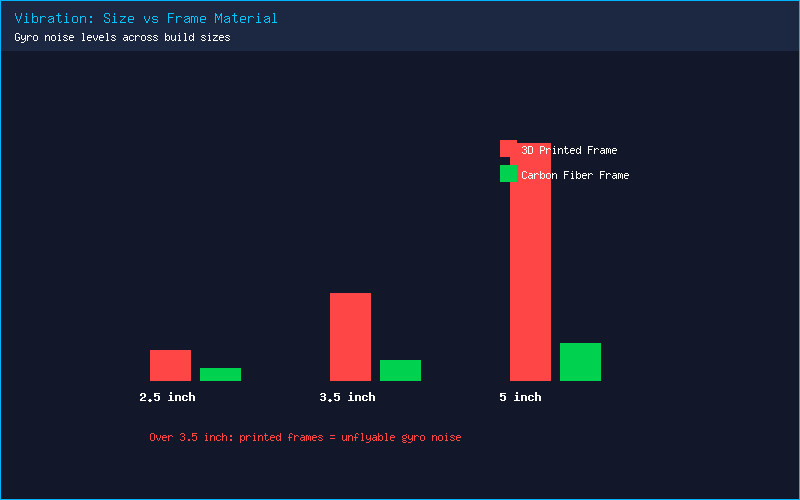
Practical testing from the community reveals that 3D printed frames are viable for 2.5-inch and smaller builds using 1103-1204 motors spinning 2.5-3 inch props. At this scale, vibration amplitudes are low enough that modern gyro filtering handles them effectively. The Dave_C Flex-25 and NBD Hummingbird printed frames have accumulated hundreds of successful flights. Scale up to 5 inches and 2207 motors, however, and most printed frames either shake themselves apart or produce unflyable gyro noise within the first few packs.
When to Print, When to Buy
For micro and toothpick-class builds under 3 inches, a well-designed 3D printed frame in carbon-fiber nylon is a legitimate alternative to carbon fiber — especially if you enjoy iterating on designs or need a custom geometry that no commercial frame provides. For anything 3.5 inches and larger, stick with carbon fiber for the frame structure and use 3D printing for accessories (mounts, guards, bumpers) where flexibility and shape complexity matter more than absolute strength.
The future is promising: continuous-fiber 3D printing (Markforged technology) that embeds strands of carbon fiber, fiberglass, or Kevlar within a nylon matrix produces parts approaching the strength of traditional composites. Desktop machines with this capability are still expensive ($5,000+), but as the technology matures and prices fall, fully printed frames that rival carbon fiber performance will become a reality.
For now, 3D print your camera mounts, your antenna holders, and your arm guards. Buy your frame arms from a reputable carbon fiber manufacturer. Your flight controller will thank you, and you will spend more time flying than reprinting.
Have you tried a 3D printed frame? What size quad and what material did you use? Share your experience below!