
Why Antenna Polarization Is the Most Overlooked FPV Variable
Ask the average FPV pilot about their video signal and they will talk about VTX power, antenna gain, and obstacle penetration. But one factor silently determines whether your signal is crystal clear or riddled with multipath interference: antenna polarization. Understanding the difference between RHCP, LHCP, and linear polarization — and when to use each — can dramatically improve your FPV experience.
How Polarization Works
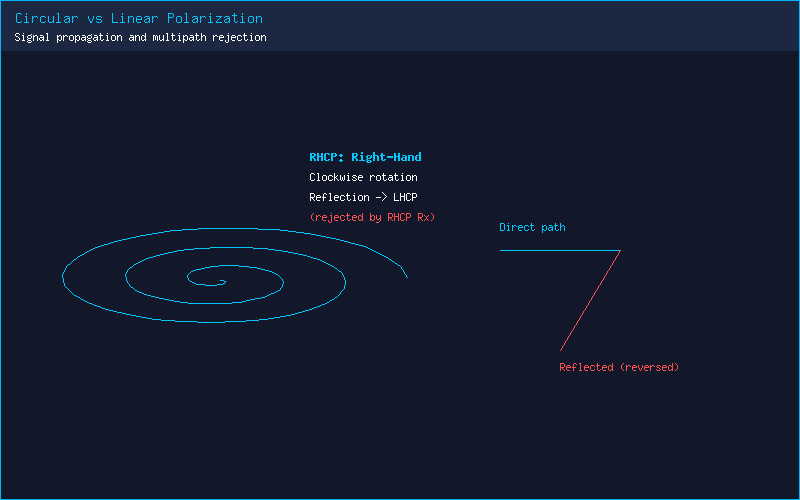
Radio waves oscillate in a specific orientation as they travel through space. A vertically polarized antenna emits waves that oscillate up and down. A circularly polarized antenna emits waves that rotate — either clockwise (RHCP, Right-Hand Circular Polarization) or counter-clockwise (LHCP, Left-Hand Circular Polarization) — as they propagate. The receiving antenna is most sensitive to waves matching its own polarization.
The critical principle: when a circularly polarized signal reflects off a surface (building, tree, ground, water), its rotation reverses. An RHCP signal reflecting off concrete becomes LHCP. A receiving antenna tuned to RHCP will reject this reflected signal, dramatically reducing multipath interference — the ghost images and signal breakup that plague FPV feeds in urban and indoor environments.
RHCP vs LHCP: Which Should You Use?
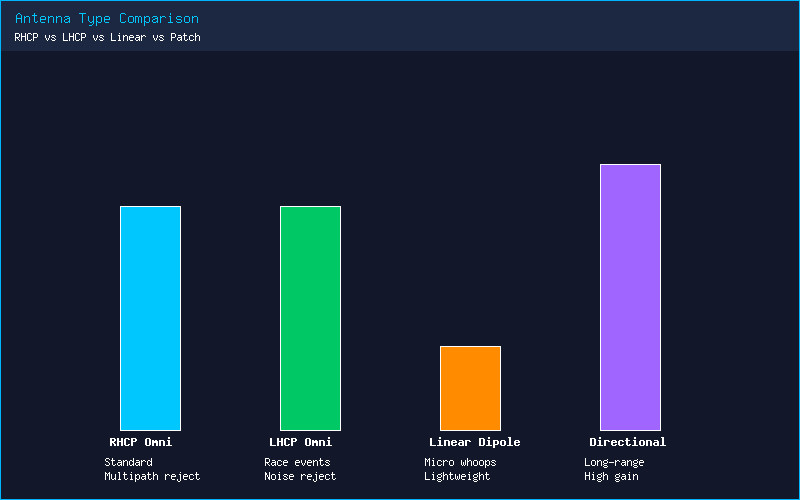
RHCP is the overwhelming standard in the FPV community. Nearly every off-the-shelf FPV antenna — from budget Foxeer Lollipops to premium TrueRC X-Airs — comes in RHCP. If you fly alone or with a small group, stick with RHCP for maximum compatibility with spare parts and flying buddies. The actual performance between RHCP and LHCP is identical; the choice only matters for signal rejection of opposite-polarity reflections.
LHCP antennas offer one significant advantage: at large FPV events and races with many pilots in the air simultaneously, switching to LHCP can dramatically reduce interference from everyone else running RHCP. Since the majority of noise in the air is RHCP, an LHCP receiving setup rejects most of it. Some race organizers even mandate alternating polarization between adjacent pilot stations.
Linear Antennas: When Simple Wins
Linear polarization — the type used by simple dipole antennas — has largely fallen out of favor in the FPV world, but it still has valid use cases. Linear antennas are lighter, cheaper, and more aerodynamic than circular alternatives. For tiny whoops and micro drones where every gram counts, a simple 50 mm dipole antenna on 25 mW is often good enough. Linear antennas also have a 3 dB advantage in direct line-of-sight signal strength compared to circular antennas because no energy is “wasted” on rotation.
However, linear antennas suffer terribly from multipath interference. Flying near buildings, trees, or even wet grass produces ghosting and signal breakup that circular polarization handles effortlessly. For any quad larger than a micro whoop, circular polarization is the clear winner.
Axial Ratio and Real-World Performance
Not all circular antennas are created equal. The axial ratio measures how perfectly circular the polarization is — lower is better. A TrueRC Singularity with a 1.0 axial ratio is near-perfect, while cheap clone antennas may have axial ratios of 3.0 or worse, performing more like linear antennas with extra weight. When purchasing antennas, look for manufacturers that publish axial ratio specifications. TrueRC, Lumenier, and VAS (Video Aerial Systems) are consistently reliable.
Installation Best Practices
Mount both transmitter and receiver antennas with the same polarization (both RHCP or both LHCP). Never mix — an RHCP transmitter with an LHCP receiver loses up to 30 dB of signal, equivalent to reducing your VTX power by a factor of 1000. Keep antennas clear of carbon fiber, battery packs, and metal standoffs — all of which distort polarization and create unpredictable null zones. For long-range flights, use a high-gain directional antenna (like a TrueRC X2-Air or VAS Pepperbox) on your goggles paired with an omni-directional antenna on the quad.
Understanding polarization transforms antenna selection from guesswork into engineering. With properly matched, high-quality circularly polarized antennas, your FPV feed will be cleaner, your range will be longer, and you will spend less time troubleshooting and more time flying.
Are you running RHCP or LHCP? Have you noticed a difference at crowded flying spots? Comment below!